
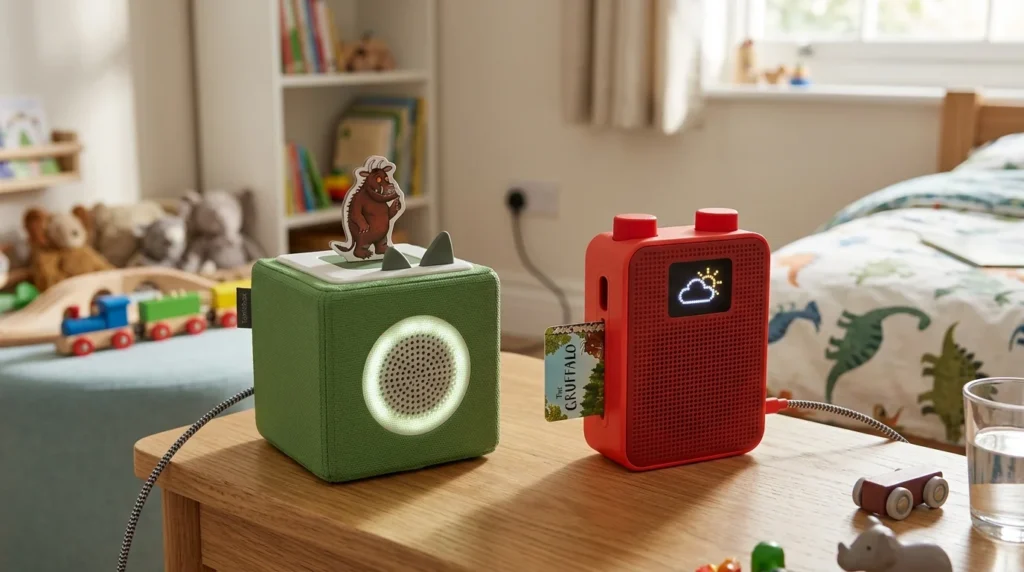
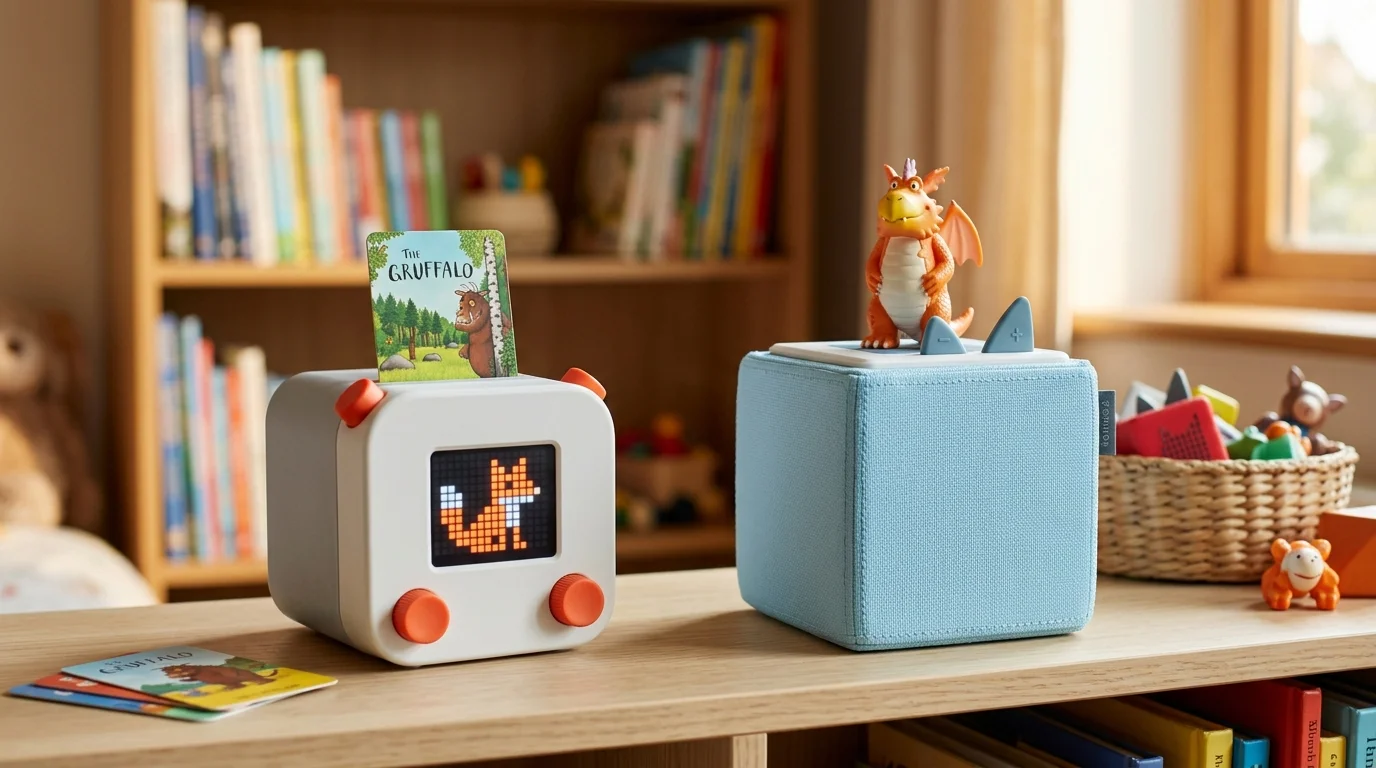
What Is “Yoto”?
Yoto is a screen-free audio platform designed primarily for children. Its players let kids listen to audio through physical cards, without needing to operate a traditional smartphone or tablet.
The two best-known devices are the Yoto Player and Yoto Mini.
How Yoto works
A child inserts a compatible Yoto Card into the player. The card tells the player what audio content to play.
Depending on the card, the content might include:
- Audiobooks
- Children’s stories
- Music
- Podcasts
- Educational audio
- Sleep content
- Interactive experiences
Yoto also offers features such as wireless connectivity and content management through its ecosystem.
Example
A child can choose a favorite story card, insert it into the player, and start listening. This physical-card system makes selecting content relatively straightforward.
Yoto Card system
One major feature of Yoto is its physical card library. Families can build a collection of cards based on their children’s interests.
Yoto also provides options for creating or adding personalized audio content through its platform, depending on the product and current service features.
Yoto Player vs Yoto Mini
The Yoto Player is designed primarily for use at home, while the Yoto Mini is a smaller, more portable option.
This can make the Mini useful for travel, although exact features and battery performance depend on the specific model.
Short history of Yoto
Yoto was created as a screen-free audio platform for children and has expanded its range of players and audio content over time.
Its basic idea is simple: physical cards + a dedicated audio player = independent listening without a traditional screen.
What Is “Tonie”?
Tonie generally refers to the Toniebox audio system, which uses small physical character figures called Tonies.
A child places a Tonie on top of the Toniebox, and the corresponding audio begins playing.
How Tonie works
Instead of inserting a card, the child selects a physical Tonie figure.
Different Tonies can contain different types of content, including:
- Stories
- Songs
- Nursery rhymes
- Educational content
- Familiar children’s characters
- Original audio adventures
The Toniebox is designed to be simple enough for children to operate with physical controls.
What are Tonies?
A Tonie is a small character figure that works with the Toniebox.
For many families, one of the appealing parts of the system is that children can physically choose a character rather than selecting content from a screen.
For example, a child might associate a particular character with a favorite story or collection of songs.
Toniebox controls
The Toniebox uses physical controls rather than requiring a touchscreen.
Children can generally use the box’s controls to manage playback, while placing or removing Tonies changes the content.
Creative-Tonie concept
Tonie also offers Creative-Tonies, which can be used for personalized audio content. Depending on the current system and available features, families can use them for recordings and other personal content.
Short history of Tonie
The Toniebox was developed in Germany and became especially popular as a child-friendly alternative to conventional screen-based entertainment.
Its central concept is:
Physical character + audio box = screen-free listening.
Yoto or Tonie: Key Differences
The biggest difference between Yoto or Tonie is how children select their content.
Yoto uses cards.
Tonie uses character figures.
That distinction affects the experience of collecting, storing, and selecting content.
Key differences
- Yoto uses audio cards.
- Tonie uses physical character figures.
- Yoto offers a card-based content library.
- Tonie offers character-based content.
- Both are designed for screen-free listening.
- Both support stories and music.
- Both can encourage independent use by children.
- Yoto has a strong emphasis on its card ecosystem.
- Tonie places a strong emphasis on collectible physical characters.
- Both offer personalized-content options through their respective ecosystems.
- Features and content availability can vary by country and product generation.
Comparison Table
| Feature | Yoto | Tonie |
|---|---|---|
| Main device | Yoto Player / Yoto Mini | Toniebox |
| Content format | Physical audio cards | Physical character figures |
| Screen-free | Yes | Yes |
| Stories | Yes | Yes |
| Music | Yes | Yes |
| Educational content | Yes | Yes |
| Personalized content | Available through supported features | Creative-Tonie system |
| Physical collecting | Cards | Character figures |
| Content selection | Insert a card | Place a Tonie on the box |
| Portability | Yoto Mini is designed for portability | Toniebox can also be moved around |
| Best-known feature | Card-based system | Character-based system |
| Brand origins | UK | Germany |
Real-Life Conversation Examples
Dialogue 1: Choosing a System
Parent: Should we get a Yoto or Tonie?
Friend: What does your child prefer?
Parent: They love collecting little characters.
Friend: Then the Tonie system might be appealing.
🎯 Lesson: Think about whether your child prefers cards or physical characters.
Dialogue 2: Audiobook Collection
Parent: How does Yoto work?
Friend: You put a Yoto Card into the player and choose the audio you want.
Parent: So it doesn’t use figures?
Friend: Right. Yoto primarily uses cards.
🎯 Lesson: Yoto = cards, while Tonie = figures.
Dialogue 3: Screen-Free Listening
Parent: I want something my child can use without a tablet.
Friend: Both Yoto and Tonie are designed for screen-free audio.
Parent: So I should compare their content and controls instead.
🎯 Lesson: Both systems are screen-free, so the decision depends on features and preferences.
Dialogue 4: Collecting Content
Child: I want another Tonie!
Parent: You really enjoy collecting them, don’t you?
Child: Yes, and each one has different stories.
🎯 Lesson: Tonies can make content selection feel like collecting physical characters.
When to Choose Yoto or Tonie
There isn’t one universal winner. The better option depends on what your family values most.
Choose Yoto if you prefer cards
Yoto may be appealing if you like the idea of a library of physical audio cards.
Cards are relatively flat and can be organized in a box, holder, or small storage area.
Yoto may also be attractive if you want a system that combines children’s audio with additional features available through its player ecosystem.
Choose Tonie if your child loves characters
Tonie may be especially appealing to children who enjoy physical figures.
The character-based approach makes the experience feel more tangible. A child can pick a Tonie based on the character they want to hear and place it on the box.
Consider Yoto for travel
If portability is important, the Yoto Mini is specifically designed as a smaller portable player.
This can be useful for:
- Car journeys
- Holidays
- Visiting relatives
- Bedrooms
- Quiet-time listening
However, always check the current specifications before purchasing because product features can change.
Consider Tonie for simple physical interaction
The Toniebox’s physical controls and character-based system can be appealing if you want your child to interact with a tangible object rather than navigate menus.
Yoto vs Tonie for Independent Use
Both Yoto and Tonie are designed to make audio selection relatively simple for children.
The physical nature of both systems can reduce the need for a child to operate a smartphone or tablet.
With Yoto, the child chooses a card.
With Tonie, the child chooses a character.
This difference may seem small, but it can significantly influence which system feels more intuitive to your child.
You may want to consider your child’s age, motor skills, interests, and familiarity with physical controls before choosing.
Yoto or Tonie for Stories and Music
Both platforms offer children’s stories and music, but their catalogs are not identical.
The available titles can depend on:
- Country
- Language
- Product generation
- Licensing agreements
- Current catalog availability
If a particular character, audiobook, music collection, or educational title matters to your family, check whether it is available for the system you are considering before buying.
This is one of the most important practical differences between Yoto or Tonie.
Easy Memory Trick
Remember it this way:
Yoto = cards
Think:
Yoto → You choose a card.
Tonie = toys/characters
Think:
Tonie → Tiny character figure.
It is not a technical rule, but it is an easy way to remember the basic difference.
Common Mistakes to Avoid
Mistake 1: Assuming Yoto and Tonie use the same content format
They don’t.
Yoto uses cards, while Tonie uses character figures.
Mistake 2: Assuming every title is available on both systems
Content libraries differ. A title available for one ecosystem may not be available for the other.
Mistake 3: Choosing only based on appearance
Both systems are designed for children, but the content, controls, accessories, and ecosystem matter more than appearance alone.
Mistake 4: Ignoring regional availability
Some content and features may vary depending on where you live. Always check the current local catalog and product specifications.
US vs UK Notes
Both Yoto and Tonie are used internationally, but their availability, catalogs, pricing, and supported content can differ by country.
Yoto originated in the United Kingdom, while Tonie originated in Germany.
For buyers in the United States, United Kingdom, Europe, or other regions, it is worth checking the locally available versions before purchasing.
In particular, verify:
- Available content
- Supported languages
- Device compatibility
- Accessories
- Subscription or content options
- Warranty and regional support
These details can change over time.
Fun Facts About Yoto and Tonie
1. Both are designed around physical interaction
Instead of asking children to browse a traditional screen, both systems use physical objects to help select audio.
2. Their core ideas are remarkably similar
Although Yoto and Tonie use different formats, both aim to make children’s audio more independent and screen-free.
The major distinction is easy to remember:
Yoto = cards.
Tonie = characters.
Quick Answer: Yoto or Tonie?
Choose Yoto if you prefer:
- Audio cards
- A card-based collection
- A compact option such as Yoto Mini
- A broader card-style content experience
Choose Tonie if you prefer:
- Character figures
- A collectible experience
- Simple physical controls
- Character-based storytelling
Neither is automatically better for every family. The right choice depends on content availability, your child’s preferences, portability, controls, and your budget.