

What Is “Since”?
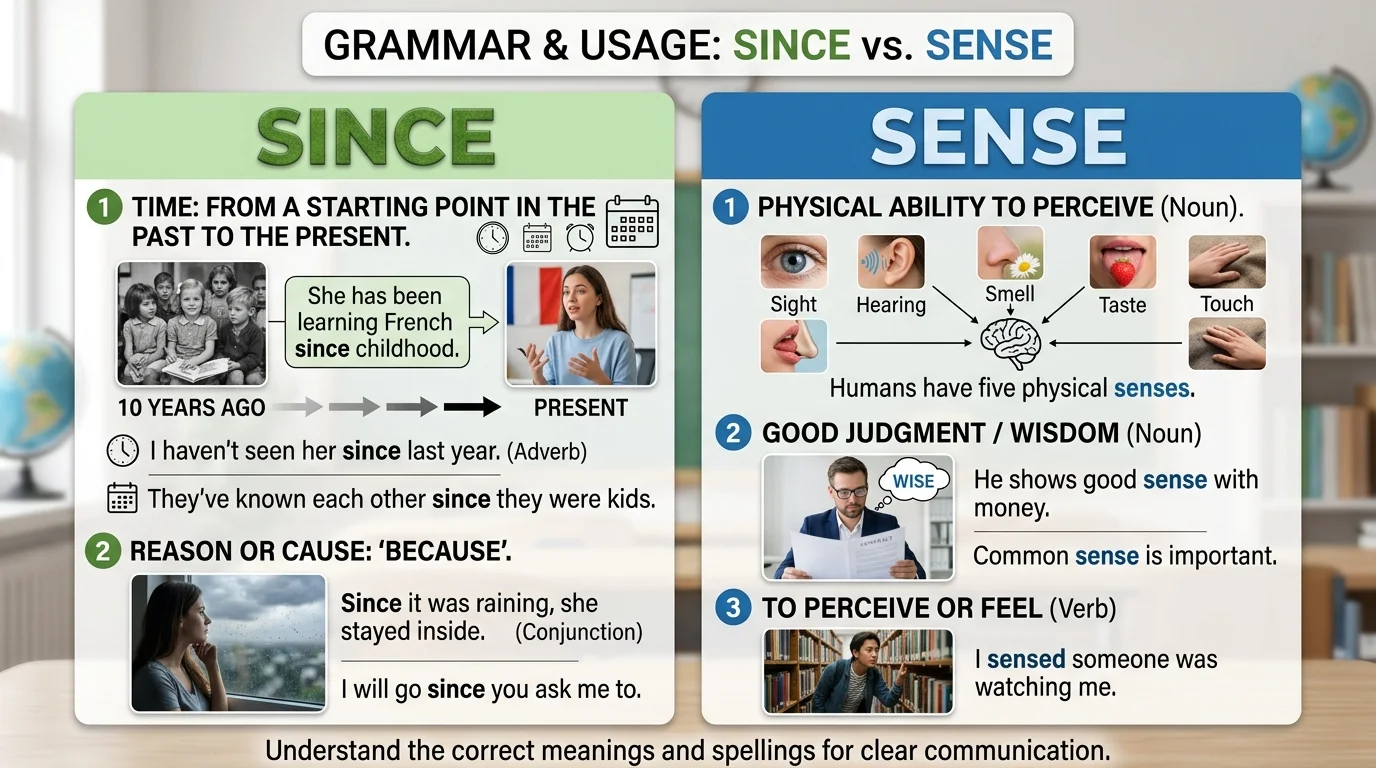
Since is the correct and standard English word. It can function mainly as a preposition, conjunction, or adverb, depending on how it is used.
Meaning 1: From a Time in the Past Until Now
One of the most common uses of since is to identify the starting point of an action or situation that continued afterward.
Examples:
“I have lived here since 2020.”
“She has worked there since Monday.”
“We have known each other since childhood.”
In these sentences, since introduces the point when something began.
Meaning 2: From a Particular Past Time
Since can also refer to something that happened after a specific past event.
“I haven’t seen him since the meeting.”
“She hasn’t visited us since last summer.”
The word connects the present situation to a point or period in the past.
Meaning 3: Because
Since can also mean because, particularly when introducing a reason.
For example:
“Since it was raining, we stayed inside.”
Here, since does not refer to time. It means because.
Grammar Rules
Since can be followed by:
- A year: since 2020
- A day: since Monday
- A time: since 8 a.m.
- An event: since the accident
- A clause: since I arrived
It is especially common with perfect tenses:
“I have studied English since 2022.”
“They have lived there since they got married.”
What Is “Sinse”?
Sinse is generally not a standard English word. In most cases, it is simply a misspelling of since.
For example:
❌ “I have lived here sinse 2020.”
✅ “I have lived here since 2020.”
The mistake is understandable because sinse may appear to match the way some speakers pronounce since.
However, in formal, academic, professional, or published writing, you should use since.
Why Do People Write “Sinse”?
English spelling does not always perfectly match pronunciation. The c in since can sound like an s, which may cause learners or writers to spell the word phonetically.
For example:
since → sounds roughly like sins
This can make sinse look plausible, but pronunciation should not be used to determine its spelling.
Is “Sinse” Ever Correct?
For normal modern English writing, sinse should be treated as a spelling error.
You might occasionally encounter it as:
- A typo
- A learner’s spelling mistake
- Informal internet writing
- A deliberately misspelled word in a fictional or humorous context
- A proper name or specialized term
Unless there is a specific reason for the unusual spelling, use since.
Key Differences Between Sinse and Since
The distinction between sinse or since is mainly a matter of standard spelling.
- Since is the correct standard English spelling.
- Sinse is generally a misspelling.
- Since can refer to time.
- Since can also mean “because.”
- Since can function as a preposition, conjunction, or adverb.
- Sinse does not normally have a standard grammatical role in English.
- Use since in school, business, academic, and professional writing.
Sinse or Since Comparison Table
| Feature | Since | Sinse |
|---|---|---|
| Standard English word | ✅ Yes | ❌ No |
| Correct modern spelling | ✅ Yes | ❌ No |
| Can refer to time | ✅ Yes | ❌ No |
| Can mean “because” | ✅ Yes | ❌ No |
| Common in formal writing | ✅ Yes | ❌ No |
| Common as a spelling mistake | No | ✅ Yes |
| Example | “I have been here since Monday.” | “I have been here sinse Monday.” ❌ |
The simple answer is:
Since = correct
Sinse = incorrect spelling in standard English
Real-Life Conversation Examples
Dialogue 1: Talking About Time
Mia: How long have you lived here?
Alex: I have lived here since 2022.
Mia: So “since” tells us when it started?
Alex: Exactly.
🎯 Lesson: Use since to identify a starting point in the past.
Dialogue 2: A Spelling Mistake
Sam: I wrote, “I’ve known her sinse school.”
Ella: It should be since school.
Sam: Right. I spelled it the way it sounded.
🎯 Lesson: Sinse is a common phonetic spelling mistake; the correct spelling is since.
Dialogue 3: Since Meaning Because
Nora: Why did you stay home?
Liam: Since I wasn’t feeling well, I stayed home.
Nora: So here “since” means “because”?
Liam: Exactly.
🎯 Lesson: Since can introduce a reason and mean because.
Dialogue 4: Formal Writing
Teacher: Your sentence says “sinse last year.”
Student: Is the spelling wrong?
Teacher: Yes. Write since last year.
🎯 Lesson: Always use since in standard English writing.
When to Use Since vs Sinse
Use “Since” for Time
Use since when something began at a particular time in the past.
Examples:
“I have been studying since morning.”
“She has lived there since 2019.”
“We haven’t spoken since Friday.”
A useful pattern is:
have/has + past participle + since + starting point
For example:
“I have worked here since January.”
Use “Since” for a Reason
You can also use since to mean because.
“Since you’re already here, let’s start.”
“Since it was late, we went home.”
Do Not Use “Sinse”
In standard English, replace sinse with since.
❌ “I haven’t seen him sinse Monday.”
✅ “I haven’t seen him since Monday.”
Since vs For: A Common Grammar Confusion
Another common mistake is confusing since with for.
Use since for a starting point:
“I have lived here since 2020.”
Use for for a duration:
“I have lived here for six years.”
Compare:
- since Monday → starting point
- for three days → duration
- since 2022 → starting point
- for four years → duration
This distinction is especially important when using the present perfect tense.
Easy Memory Trick
Remember:
SINCE = STARTING POINT
FOR = LENGTH OF TIME
So:
“I have studied here since September.”
But:
“I have studied here for two years.”
Pronunciation and Spelling
One reason people search for sinse or since is pronunciation.
The standard spelling is:
since
It is commonly pronounced like “sins.”
The spelling does not use an s where the c appears.
Think of the word as:
S-I-N-C-E
not:
S-I-N-S-E
A good spelling habit is to associate since with other words containing the same -ince pattern, such as once and hence, although their meanings are different.
US vs UK English Notes
There is no meaningful American-versus-British spelling difference here.
Both American English and British English use:
since
The incorrect spelling sinse is not a standard US or UK alternative.
For example:
US English: “I have lived here since 2020.”
UK English: “I have lived here since 2020.”
The spelling remains the same.
Common Mistakes to Avoid
Mistake 1: Writing Sinse
❌ “I have worked here sinse January.”
✅ “I have worked here since January.”
Mistake 2: Confusing Since and For
❌ “I have lived here since five years.”
✅ “I have lived here for five years.”
Mistake 3: Forgetting the Second S Sound
Although since may sound similar to “sins,” its spelling is S-I-N-C-E.
Mistake 4: Assuming Since Always Refers to Time
Since can also mean because.
“Since you are here, let’s begin.”
Understanding the context helps you identify its meaning.
Fun Facts and History
1. Since Has a Long History in English
Since developed from older English forms associated with the idea of “after that” or “from then.” Its meaning gradually expanded into the modern uses connected with time and reason.
2. Since Has More Than One Grammatical Function
Unlike many simple time words, since can work in several ways. It can introduce a starting point, connect a dependent clause, or function as an adverb.
That flexibility is one reason since appears so frequently in English.