
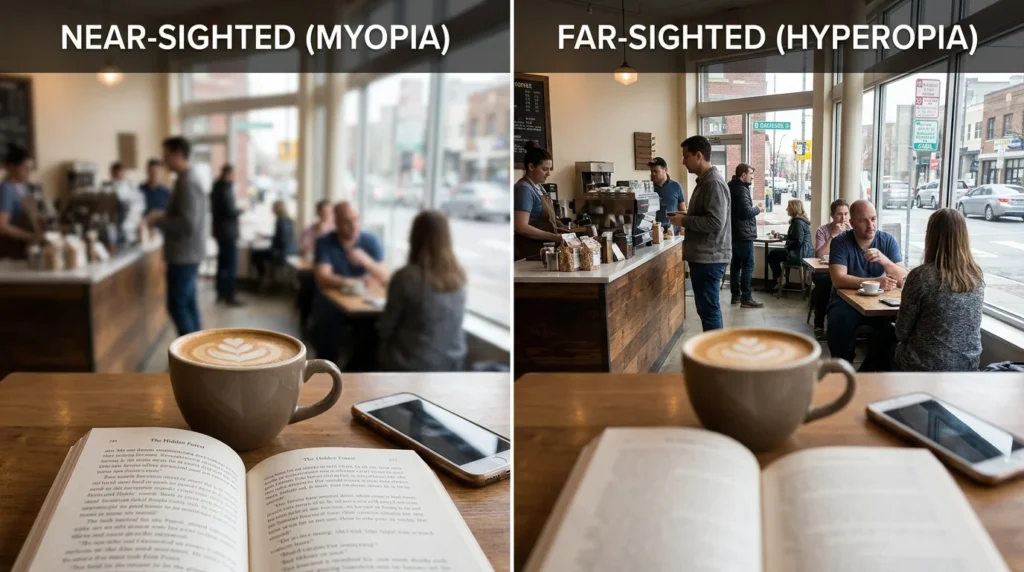

What Is “Nearsighted”?
Nearsightedness, medically called myopia, is a common refractive error in which distant objects may appear blurry while nearby objects are usually easier to see clearly.
How Nearsightedness Works
In a typical eye, incoming light is focused on the retina.
With myopia, the eye focuses light in front of the retina rather than directly on it.
This can happen because of the shape or length of the eye or differences in how the cornea or lens focuses light.
Common Examples
Someone with nearsightedness might:
- Read a book clearly
- See a phone screen clearly
- Have difficulty reading a distant sign
- Struggle to see the board clearly from the back of a classroom
- Squint when looking at distant objects
For example:
“I can read my phone easily, but the road sign looks blurry.”
Correcting Nearsightedness
Myopia can commonly be corrected with:
- Prescription eyeglasses
- Contact lenses
- Certain refractive procedures for eligible adults
An eye-care professional determines the appropriate prescription after an eye examination.
What Is “Farsighted”?
Farsightedness, medically called hyperopia, is another refractive error.
It can make nearby objects difficult to focus on clearly, although the experience varies according to age and the degree of hyperopia.
How Farsightedness Works
With hyperopia, incoming light tends to focus behind the retina when the eye is not accommodating enough to bring the image into focus.
The eye’s focusing system can sometimes compensate, particularly in younger people.
Common Symptoms
Depending on the degree of hyperopia, a person may experience:
- Difficulty focusing on close objects
- Eye strain
- Headaches after close-up work
- Blurred near vision
- Difficulty maintaining comfortable focus
For example:
“Reading for a long time makes my eyes feel tired.”
Correcting Farsightedness
Depending on the individual’s needs, hyperopia may be corrected with:
- Prescription eyeglasses
- Contact lenses
- Certain refractive procedures for eligible adults
An eye examination is needed to determine whether someone is farsighted and what correction, if any, is appropriate.
Nearsighted or Farsighted: Key Differences
When comparing nearsighted or farsighted, the easiest distinction is the distance at which focusing becomes difficult.
- Nearsightedness = myopia.
- Farsightedness = hyperopia.
- Myopia commonly causes distant objects to appear blurry.
- Hyperopia can make near focusing difficult.
- Myopia occurs when the eye’s optical system focuses light in front of the retina.
- Hyperopia occurs when light would focus behind the retina without enough accommodation.
- Both are refractive errors.
- Both can often be corrected with prescription lenses.
- An eye examination is needed for an accurate diagnosis.
Comparison Table
| Feature | Nearsightedness | Farsightedness |
|---|---|---|
| Medical term | Myopia | Hyperopia |
| Common problem | Distance vision | Near focusing |
| Distant objects | Often blurry | May be clearer |
| Nearby objects | Usually clearer | Can be difficult to focus on |
| Light focus | In front of retina | Behind retina |
| Common correction | Prescription lenses | Prescription lenses |
| Other symptoms | Squinting, distance blur | Eye strain, headaches, near blur |
Real-Life Conversation Examples
Dialogue 1: Seeing the Board
Student 1: “I can read my notebook, but the board looks blurry.”
Student 2: “That can be a symptom associated with nearsightedness.”
🎯 Lesson: Difficulty seeing distant objects is commonly associated with myopia.
Dialogue 2: Reading
Person 1: “Reading for a long time makes my eyes uncomfortable.”
Person 2: “Some people with farsightedness experience difficulty or strain during close-up work.”
🎯 Lesson: Near focusing problems can occur with hyperopia.
Dialogue 3: The Names
Person 1: “Which one means trouble seeing far away?”
Person 2: “Nearsightedness—despite the name, it means nearby objects are generally easier to see.”
🎯 Lesson: Nearsighted = near objects are easier to see clearly.
Dialogue 4: Eye Examination
Person 1: “Can I tell whether I’m nearsighted or farsighted just from symptoms?”
Person 2: “An eye examination is the best way to determine the cause of vision problems.”
🎯 Lesson: Symptoms alone don’t provide a reliable diagnosis.
When to Use Nearsighted or Farsighted
Think “Near” for Nearsighted
The simplest memory trick is:
Nearsighted → near is clearer.
A person with myopia can often see close objects more clearly than distant ones.
Think “Far” for Farsighted
Another helpful memory trick is:
Farsighted → far is relatively easier to focus on than near.
However, farsightedness doesn’t necessarily mean someone has exceptionally good distance vision. The exact visual experience depends on the person’s age and degree of hyperopia.
Nearsighted or Farsighted: Causes
Causes of Nearsightedness
Myopia is associated with the eye’s shape and optical system. Genetics and environmental factors can both play roles.
Children and teenagers can develop or experience changes in myopia as their eyes grow.
Causes of Farsightedness
Hyperopia is also related to the eye’s shape and focusing system.
Some people are born with hyperopia, and its effects can vary as the eye develops.
Nearsighted or Farsighted in Children
Vision can change during childhood and adolescence.
A child may not always realize that their vision isn’t clear because they may assume everyone sees the same way.
Possible signs include:
- Squinting
- Sitting unusually close to screens or books
- Difficulty seeing classroom material
- Frequent headaches
- Avoiding reading
- Difficulty with visually demanding activities
Regular vision screening and comprehensive eye examinations can help identify problems.
Nearsighted or Farsighted: Glasses
Eyeglasses can correct both conditions, but the lenses work differently.
Myopia
Myopia is typically corrected using minus-powered (concave) lenses that help move the focal point back onto the retina.
Hyperopia
Hyperopia is typically corrected using plus-powered (convex) lenses that help bring the focal point forward onto the retina.
The correct prescription should always come from an eye-care professional.
Common Mistakes
Mistake 1: Thinking Nearsighted Means Near Vision Is Bad
The term can sound misleading.
Nearsightedness usually means near objects are easier to see than distant objects.
Mistake 2: Assuming Farsightedness Means Perfect Distance Vision
Hyperopia doesn’t automatically mean someone sees distant objects perfectly.
The focusing system can compensate to different degrees.
Mistake 3: Diagnosing Yourself
Blurred vision can have many causes.
A professional eye examination is the appropriate way to determine whether someone has myopia, hyperopia, or another vision condition.
Mistake 4: Confusing Hyperopia With Presbyopia
These are different conditions.
Hyperopia is farsightedness related to the eye’s focusing geometry.
Presbyopia is an age-related reduction in the eye’s ability to focus on nearby objects.
Fun Facts or History
1. Myopia Is Very Common
Nearsightedness is one of the most common refractive errors worldwide.
2. The Names Describe Relative Focusing Ability
The terms nearsighted and farsighted describe which viewing distances are generally easier or more difficult to focus on, rather than meaning that a person’s vision is literally limited to one distance.