
What Is a Jeep?
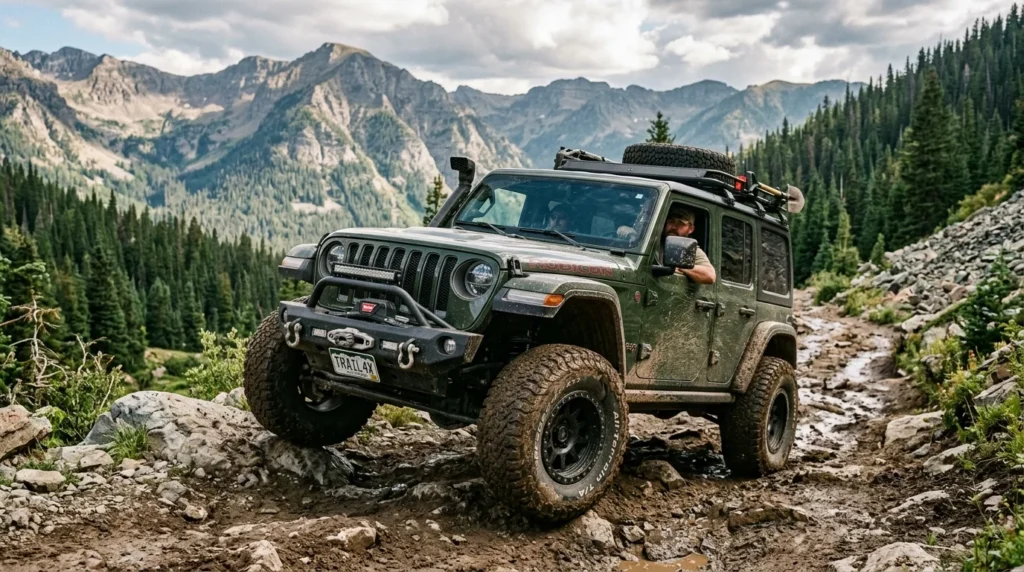
Jeep is an automotive brand best known for SUVs and off-road-oriented vehicles. Its history goes back to the 1940s, and the brand has built a strong identity around four-wheel-drive capability, adventure, and rugged vehicle design.
Today, the Jeep lineup includes several types of vehicles. The Wrangler is particularly associated with traditional off-road driving, while models such as the Grand Cherokee and Grand Wagoneer focus more heavily on passenger comfort and family practicality. Jeep also offers the Gladiator, which is a mid-size pickup truck.
What Makes a Jeep Different?
Depending on the model, a Jeep can offer:
- 4×4 capability
- High ground clearance
- Off-road-oriented equipment
- SUV passenger space
- Flexible cargo areas
- Removable roof or doors on certain models
- Multiple drivetrain choices
- Adventure-focused styling
The Wrangler is a particularly recognizable example. Its design emphasizes open-air driving and off-road capability.
However, not every Jeep is built for the same purpose. A small crossover and a rugged Wrangler can provide very different driving experiences.
Example
Imagine someone regularly drives on paved roads but occasionally travels on rough trails.
A Jeep SUV could provide a useful combination of everyday transportation and off-road capability.
This is an important point when comparing Jeep or truck: “Jeep” describes a brand with many different vehicle types, while “truck” generally describes a vehicle category.
What Is a Truck?
A truck, especially in the context of this comparison, usually means a pickup truck.
A pickup typically has:
- A passenger cabin
- Four wheels
- A separate or integrated cargo bed
- Towing capability
- Payload capacity
- Various drivetrain options
The biggest advantage of a pickup truck is its open cargo bed.
You can use the bed for things that may be inconvenient to place inside an SUV, such as bulky equipment, outdoor gear, or certain building materials.
What Makes a Truck Different?
Pickup trucks are commonly designed around:
- Cargo carrying
- Towing
- Payload capacity
- Work use
- Passenger transportation
- Long-distance driving
- Recreational activities
Truck sizes vary significantly. Compact, midsize, and full-size pickups can have very different capabilities.
Therefore, when comparing Jeep or truck, it is important to compare vehicles in similar size and capability categories.
Jeep or Truck: Key Differences
The most important difference between Jeep or truck is the way each vehicle handles passengers and cargo.
A traditional Jeep SUV keeps cargo inside a covered rear area.
A pickup truck provides an open bed that is especially useful for bulky or dirty cargo.
Main Differences
- Jeep SUVs generally prioritize passenger and enclosed cargo space.
- Pickup trucks provide an open cargo bed.
- Jeep has a strong off-road heritage.
- Trucks are often designed around towing and payload requirements.
- Some Jeep models are highly maneuverable off-road.
- Trucks can offer greater cargo-bed capacity.
- Both can be equipped with four-wheel drive.
- Both can be comfortable daily drivers.
- Exact capabilities vary significantly by model.
- The best choice depends on how you plan to use the vehicle.
Comparison Table
| Feature | Jeep SUV | Pickup Truck |
|---|---|---|
| Main purpose | Passenger + adventure versatility | Cargo + passenger + work |
| Cargo location | Enclosed rear area | Open truck bed |
| Off-road ability | Excellent on suitable models | Varies by model |
| Towing | Available on certain models | Often a major strength |
| Payload | Moderate to high depending on model | Often a major strength |
| Passenger comfort | Strong | Strong, depending on cab |
| Cargo protection | Excellent | Requires cover for weather protection |
| Maneuverability | Often excellent on smaller models | Depends on size |
| Family use | Excellent | Excellent on crew-cab models |
| Work use | Good | Excellent |
| Open-air driving | Available on certain Jeep models | Generally not a core feature |
| Best for | Adventure + passenger versatility | Towing + hauling + work |
Jeep or Truck for Off-Road Driving
If off-road capability is your main priority, a suitable Jeep can be an excellent choice.
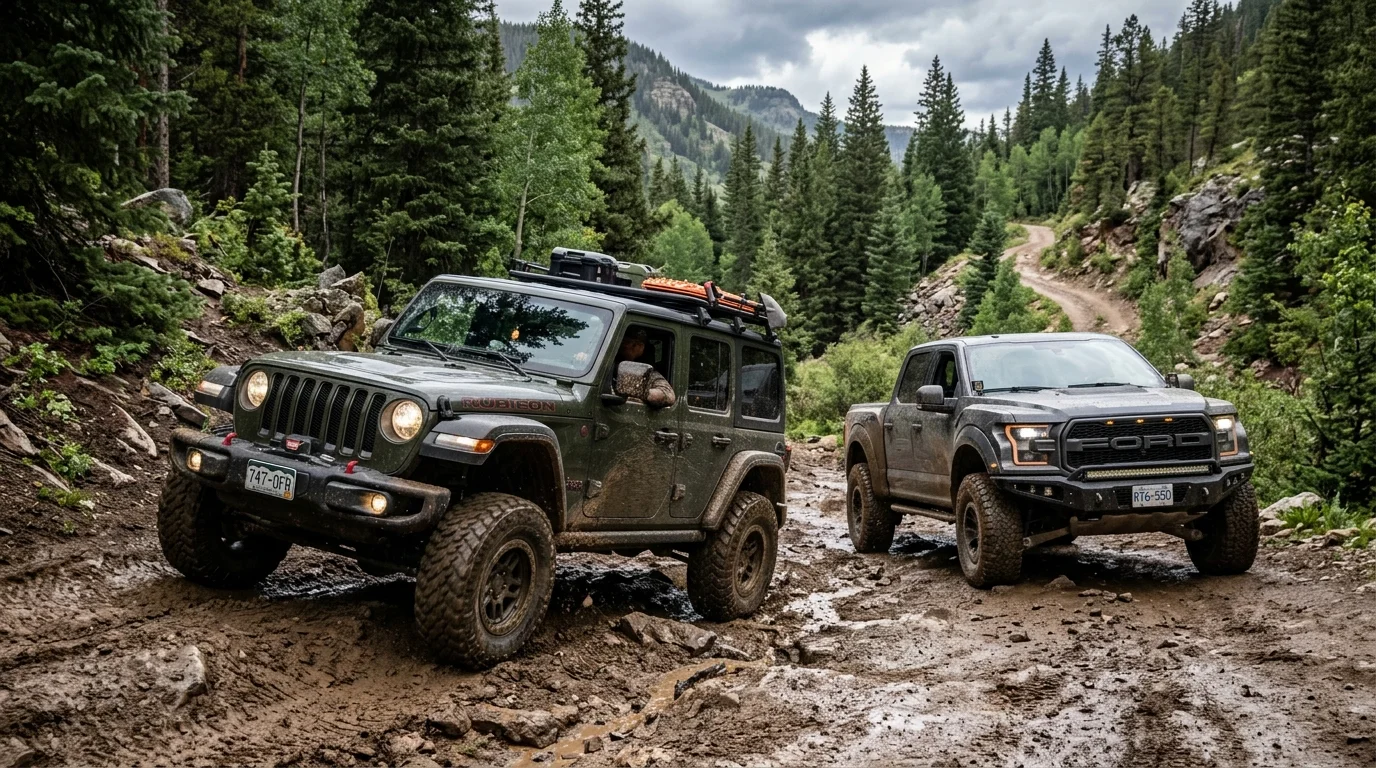
The Wrangler, in particular, has a strong off-road identity. Depending on configuration, features can include four-wheel drive, specialized traction systems, high ground clearance, and hardware designed for rough terrain.
But pickup trucks can also be excellent off-road vehicles.
Many manufacturers offer dedicated off-road pickup variants with features such as:
- Four-wheel drive
- Off-road tires
- Increased ground clearance
- Specialized suspension
- Underbody protection
- Terrain-management systems
Therefore, the real question isn’t simply Jeep or truck.
Instead, ask:
Which specific model is designed for the type of terrain I encounter?
A purpose-built off-road truck can outperform an ordinary SUV on certain terrain, while a dedicated Jeep off-roader can have advantages in maneuverability and specialized trail features.
Jeep or Truck for Towing
If towing is your biggest priority, a pickup truck will often be the more natural choice.
Trucks are specifically engineered around towing and payload requirements. Depending on the model, they can offer substantial towing capacity and equipment designed for trailers.
However, some Jeep vehicles also provide meaningful towing capability.
The key factors include:
- Engine
- Transmission
- Wheelbase
- Axle configuration
- Tow package
- Trailer brakes
- Vehicle weight
- Gross vehicle weight rating
- Manufacturer’s maximum tow rating
Never determine towing ability simply by looking at the vehicle’s size.
Always check the exact vehicle’s manufacturer’s specifications.
Simple Rule
Frequent heavy towing → Truck
Occasional towing + SUV versatility → Suitable Jeep SUV
The exact requirements should determine the final choice.
Jeep or Truck for Cargo
This is one category where a pickup truck has a major advantage.
A truck bed is specifically designed to carry bulky items.
For example, a pickup can be useful for transporting:
- Outdoor equipment
- Large boxes
- Tools
- Camping gear
- Gardening supplies
- Certain building materials
A Jeep SUV can still carry plenty of cargo, especially when its rear seats fold down.
However, enclosed cargo space has limitations when you’re carrying dirty, wet, oversized, or unusually shaped objects.
A truck bed can separate cargo from passengers and the interior.
Winner for Open Cargo
Pickup truck
Winner for Weather-Protected Cargo
SUV
A truck bed can also be covered, but that adds equipment and may reduce some of the convenience of an open bed.
Jeep or Truck for Family Use
Both vehicles can work well for families.
A Jeep SUV can provide:
- Enclosed cargo
- Multiple seating rows on certain models
- Easy passenger access
- Family-friendly storage
- Available advanced technology
Jeep’s current lineup includes models ranging from smaller SUVs to larger family-oriented vehicles.
A crew-cab pickup can also provide generous passenger space, along with the flexibility of a cargo bed.
For families who frequently carry sports equipment, bicycles, outdoor gear, or bulky objects, a truck can be particularly useful.
For families who primarily need enclosed luggage and passenger space, an SUV may be more convenient.
Jeep or Truck for Daily Driving
For everyday commuting, the best choice depends heavily on vehicle size and configuration.
A smaller Jeep SUV may be easier to maneuver and park than a large pickup.
A midsize truck can provide a useful balance between cargo capability and daily drivability.
A full-size truck can offer substantial interior room but may require more space when parking or navigating narrow roads.
Consider:
- Parking space
- Road width
- Fuel consumption
- Ride comfort
- Visibility
- Passenger needs
- Cargo requirements
- Driving distance
Don’t assume a larger vehicle is automatically more practical.
If you rarely haul or tow anything, a huge truck may provide capability you don’t regularly use.
Jeep or Truck for Comfort
Comfort depends more on the individual vehicle than the broad category.
Some modern pickups offer extremely comfortable cabins with advanced technology, supportive seats, and quiet interiors.
Some Jeep SUVs also emphasize premium comfort.
The Wrangler is a special case because its rugged design prioritizes open-air capability and off-road functionality. It can therefore feel different from a road-focused SUV.
If your primary use is highway travel, compare:
- Seat comfort
- Cabin noise
- Ride quality
- Suspension tuning
- Climate control
- Infotainment
- Driver-assistance features
A test drive can be more useful than simply comparing specifications.
Jeep or Truck for Fuel Economy
Fuel economy varies widely among vehicles.
A small Jeep crossover can have very different fuel consumption from a larger Wrangler or Grand Wagoneer.
Likewise, a compact pickup can be much more efficient than a heavy-duty full-size truck.
When comparing Jeep or truck, look at the exact:
- Engine
- Transmission
- Vehicle weight
- Drivetrain
- Tire type
- Aerodynamics
- Hybrid or electric technology
A smaller vehicle may use less fuel simply because it has less weight and a smaller engine.
If fuel efficiency is important, compare official economy figures for the exact models you are considering.
Jeep or Truck for Snow and Rough Weather
Both Jeeps and trucks can be equipped for challenging weather.
Four-wheel drive or all-wheel drive can improve traction, but drivetrain configuration alone doesn’t guarantee good performance.
Tires are extremely important.
For snowy conditions, consider:
- Proper winter tires where appropriate
- Ground clearance
- Traction systems
- Vehicle weight
- Driving conditions
- Manufacturer recommendations
A well-equipped Jeep can perform confidently in difficult conditions.
A properly equipped truck can also be highly capable.
The vehicle should match the actual environment rather than simply relying on its reputation.
Jeep or Truck for Adventure
If you enjoy outdoor activities, both categories offer strong advantages.
A Jeep can be appealing for:
- Trail exploration
- Camping
- Scenic drives
- Open-air driving
- Off-road recreation
A pickup truck can be useful for:
- Camping equipment
- Bikes
- Outdoor gear
- Towing recreational equipment
- Carrying bulky supplies
The choice comes down to how you adventure.
If the experience itself involves navigating trails, a capable Jeep can be attractive.
If the adventure requires transporting lots of equipment, a pickup’s bed can be more useful.
Jeep or Truck: Real-Life Conversation Examples
Example 1: The Off-Road Enthusiast
Alex: “I want a vehicle mainly for trail driving and weekend adventures.”
Sam: “Look at dedicated off-road SUVs and compare their ground clearance, traction systems, and wheelbase.”
🎯 Lesson: Off-road priorities should guide the vehicle choice.
Example 2: The Contractor
Alex: “I regularly carry tools and bulky equipment.”
Sam: “A pickup bed could make loading and transporting that equipment easier.”
🎯 Lesson: Frequent cargo hauling favors a truck.
Example 3: The Family Driver
Alex: “I need comfortable passenger space and room for luggage.”
Sam: “Compare family SUVs and crew-cab trucks based on the space you actually need.”
🎯 Lesson: Family requirements matter more than brand loyalty.
Example 4: The Occasional Hauler
Alex: “I only carry large items a few times a year.”
Sam: “An SUV may be enough if you don’t regularly need an open cargo bed.”
🎯 Lesson: Don’t buy maximum capability if you rarely use it.
When to Choose a Jeep or Truck
Choose a Jeep SUV If You Want:
- Strong off-road capability
- SUV practicality
- Enclosed cargo
- Adventure-oriented driving
- Easy passenger transportation
- Available four-wheel-drive options
- A vehicle with an established off-road identity
Choose a Truck If You Want:
- An open cargo bed
- Strong towing capability
- High payload capacity
- Work-oriented practicality
- Space for bulky equipment
- A vehicle suited to frequent hauling
Consider a Jeep Gladiator If You Want Both
There’s an important exception to the traditional Jeep or truck comparison: the Jeep Gladiator.
The Gladiator combines Jeep’s off-road-oriented identity with a pickup-truck bed. Jeep describes the Gladiator as a mid-size pickup truck, making it an interesting option for buyers who want characteristics of both categories.
It can therefore be a middle-ground choice for someone who wants:
- Jeep styling
- Off-road capability
- Open cargo space
- Pickup practicality
However, buyers should still compare its size, towing capacity, payload, comfort, and price against other midsize pickups.
Common Mistakes When Choosing
1. Buying Based Only on Appearance
A rugged-looking vehicle may not match your actual needs.
2. Ignoring Cargo Requirements
Think about what you carry every week, not just what you might carry once a year.
3. Overlooking Vehicle Size
Large trucks can be difficult to park in tight spaces.
4. Assuming Every Jeep Is an Off-Road Specialist
Jeep sells several different types of vehicles. Their capabilities vary significantly.
5. Ignoring Towing Specifications
If towing is important, compare the exact configuration and manufacturer’s rating.
6. Forgetting Tire Choice
Tires can have a major effect on traction, comfort, noise, and fuel consumption.
7. Comparing Categories Instead of Models
“Jeep vs truck” is a useful starting point, but specific model vs specific model is a much better comparison.
Fun Facts and History
1. Jeep’s Origins Go Back to the 1940s
Jeep’s official history traces the first Jeep model to the early 1940s. The brand’s early military connection helped establish its rugged identity, which later developed into recreational and consumer vehicles.
2. Jeep Makes a Pickup
Many people associate Jeep exclusively with SUVs, but the Gladiator is a pickup truck. This gives Jeep a unique place in the comparison because buyers can get Jeep’s off-road-focused identity in a pickup format.