
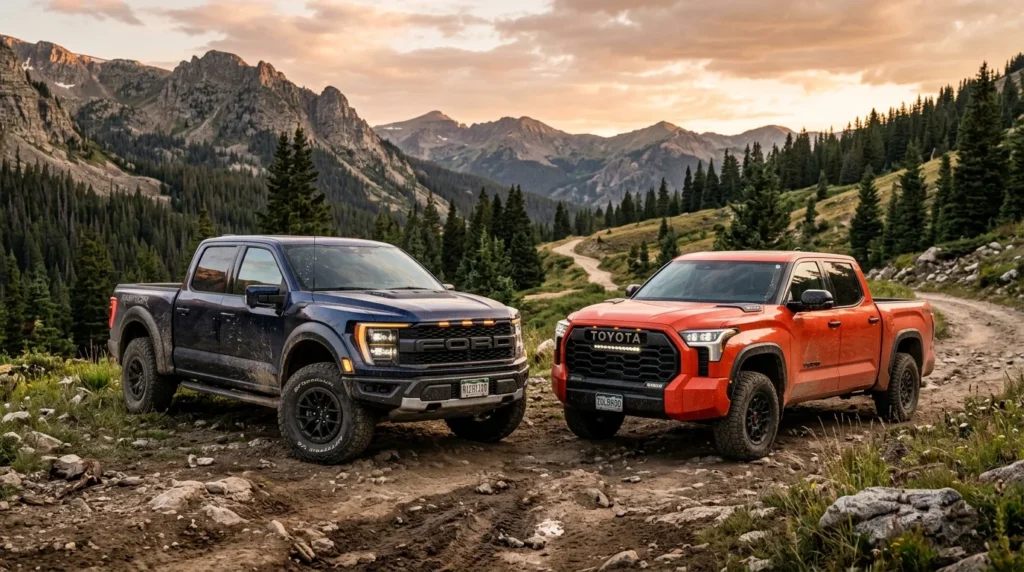
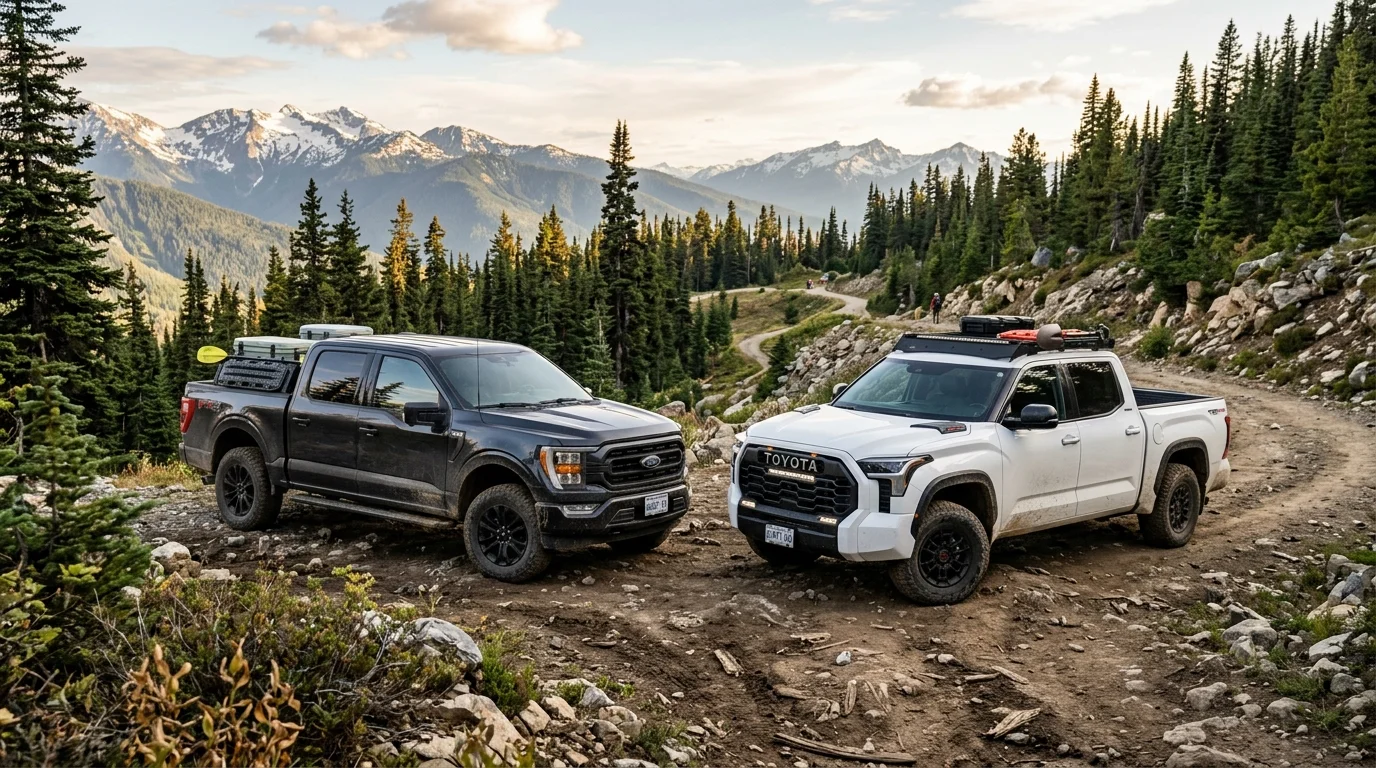
What Is the Ford F-150?
The Ford F-150 is Ford’s full-size light-duty pickup and part of the larger F-Series family.
It has a long history in the North American truck market and is available in numerous configurations designed for commuting, work, towing, off-road driving, and recreation.
F-150 Powertrain Choices
One of the biggest advantages of the F-150 is its broad powertrain selection.
For 2026, Ford lists:
- 2.7L EcoBoost V6
- 3.5L EcoBoost V6
- 3.5L PowerBoost Full Hybrid V6
- 5.0L V8
- 3.5L High-Output EcoBoost V6
- 5.2L supercharged V8
Ford’s official 2026 towing guide lists maximum available towing of 13,500 pounds for an appropriately equipped 3.5L EcoBoost configuration.
Why Choose an F-150?
The F-150 can appeal to drivers who want:
- Many engine choices
- Strong towing capability
- Multiple cab and bed configurations
- Hybrid availability
- Off-road variants
- High-performance options
- A wide range of trim levels
The breadth of the lineup is one of the most important factors in the F150 or Tundra comparison.
What Is the Toyota Tundra?
The Toyota Tundra is Toyota’s full-size pickup truck.
The current Tundra uses a 3.4L twin-turbo V6 family, with both standard i-FORCE and hybrid i-FORCE MAX powertrains.
For 2026, Toyota lists:
i-FORCE: 389 horsepower and 479 lb.-ft. of torque
i-FORCE MAX: 437 horsepower and 583 lb.-ft. of torque
Both use a 10-speed automatic transmission.
Why Choose a Tundra?
The Tundra may appeal to drivers who want:
- Strong twin-turbo V6 performance
- Available hybrid power
- Off-road-oriented TRD models
- A comfortable cabin
- Large cargo-bed options
- Toyota’s truck platform and technology
Toyota offers the Tundra with several bed lengths, including 5.5-foot, 6.5-foot, and 8.1-foot configurations.
F150 or Tundra: Key Differences
The main differences between F150 or Tundra are their powertrain strategies, maximum towing figures, configurations, and feature availability.
- The F-150 offers a larger variety of powertrains.
- The Tundra concentrates on twin-turbo V6 and hybrid twin-turbo V6 powertrains.
- The 2026 F-150 reaches up to 13,500 pounds of maximum available towing in a properly equipped configuration.
- The 2026 Tundra lists up to 12,000 pounds of maximum towing.
- The F-150 offers a traditional V8 option.
- The Tundra offers the i-FORCE MAX hybrid powertrain.
- Both offer off-road-oriented configurations.
- Both offer multiple bed and cab configurations.
- Both can serve as daily drivers or work trucks.
- Exact performance depends heavily on configuration.
Comparison Table
| Feature | Ford F-150 | Toyota Tundra |
|---|---|---|
| Vehicle type | Full-size pickup | Full-size pickup |
| 2026 powertrain choices | 6 listed by Ford | 2 main powertrain families |
| Base engine family | 2.7L EcoBoost V6 | 3.4L twin-turbo V6 |
| Available hybrid | Yes | Yes |
| Available V8 | Yes | No |
| Max towing | Up to 13,500 lbs. | Up to 12,000 lbs. |
| Max payload | Up to 2,440 lbs. | Up to 1,850 lbs. |
| Transmission | 10-speed automatic | 10-speed automatic |
| Bed lengths | Multiple configurations | 5.5, 6.5, 8.1 ft. |
| Off-road options | Available | TRD Off-Road and TRD Pro |
| Main advantage | Powertrain variety | Twin-turbo performance and hybrid option |
The figures above are manufacturer maximums and cannot necessarily be achieved simultaneously. Actual capability depends on configuration, options, passengers, cargo, and equipment.
F150 or Tundra for Towing
If towing is your primary reason for buying a truck, the F-150 has an advantage in maximum published capacity.
Ford lists up to 13,500 pounds of maximum available conventional towing for the 2026 F-150 when properly equipped.
Toyota lists 12,000 pounds of maximum towing for the 2026 Tundra.
F-150 Towing
Ford’s towing guide shows that towing capacity varies substantially by:
- Engine
- Cab configuration
- Drive configuration
- Axle ratio
- Tow package
- Wheelbase
- Payload
- Trailer setup
For example, the 2026 3.5L EcoBoost V6 can reach the highest published F-150 towing figure when properly equipped.
Tundra Towing
The Tundra also offers dedicated towing technology.
Toyota lists features such as:
- Integrated trailer brake controller
- Trailer-sway control
- Trailer Backup Guide
- Straight Path Assist on applicable configurations
These features are designed to make towing easier and more controlled.
Towing Winner
F-150, based on maximum published towing capacity.
However, if your trailer is well below both trucks’ maximum ratings, other factors may matter more.
F150 or Tundra for Payload
Payload is different from towing.
Payload is the weight the truck can carry, including passengers and cargo.
Ford lists a maximum available F-150 payload of 2,440 pounds for a specified 3.5L EcoBoost configuration.
Toyota lists 1,850 pounds maximum payload for the 2026 Tundra.
What Does This Mean?
If you regularly carry:
- Tools
- Equipment
- Building materials
- Camping gear
- Heavy cargo
the F-150’s higher published maximum payload may be attractive.
However, the payload of the actual truck you buy can be considerably lower depending on configuration and options.
Always check the door-jamb payload label on the specific vehicle.
F150 or Tundra for Engines
The engine comparison is one of the strongest reasons to consider F150 or Tundra carefully.
F-150 Engine Lineup
Ford provides several choices, including:
2.7L EcoBoost V6
325 horsepower / 400 lb.-ft.
3.5L EcoBoost V6
382 horsepower / 500 lb.-ft.
3.5L PowerBoost Hybrid V6
420 horsepower / 570 lb.-ft.
5.0L V8
400 horsepower / 410 lb.-ft.
Ford also offers specialized high-performance engines in Raptor variants.
Tundra Engine Lineup
Toyota’s 2026 Tundra offers two main powertrain families.
i-FORCE:
389 horsepower / 479 lb.-ft.
i-FORCE MAX:
437 horsepower / 583 lb.-ft.
Engine Winner
F-150 for variety.
Tundra for a straightforward twin-turbo V6 lineup with a powerful hybrid option.
F150 or Tundra for Hybrid Power
Both trucks offer hybrid powertrains, but they take slightly different approaches.
Ford’s PowerBoost Full Hybrid V6 produces 420 horsepower and 570 lb.-ft. of torque in the 2026 F-150.
Toyota’s i-FORCE MAX produces 437 horsepower and 583 lb.-ft. of torque.
Which Hybrid Is Better?
It’s not enough to compare horsepower alone.
Also consider:
- Fuel economy
- Towing needs
- Payload
- Purchase price
- Driving style
- Available equipment
The Tundra currently has the higher published hybrid horsepower and torque figures, while the F-150 gives buyers a wider overall powertrain menu.
F150 or Tundra for Off-Road Driving
Both trucks have dedicated off-road options.
F-150 Off-Road
The F-150 lineup includes the Raptor, which is Ford’s highly specialized off-road performance truck.
The Raptor focuses heavily on:
- High-speed off-road driving
- Specialized suspension
- Aggressive tires
- Increased ground clearance
- High-performance powertrains
Ford’s 2026 towing guide identifies the high-output 3.5L EcoBoost as a Raptor-only engine and the 5.2L supercharged V8 as a Raptor R powertrain.
Tundra Off-Road
Toyota offers TRD Off-Road and TRD Pro configurations.
Toyota describes the TRD family as providing multiple paths for off-road driving, while the TRD Pro is designed for more serious off-road use.
Off-Road Winner
For high-performance desert-style off-roading, the F-150 Raptor is a particularly specialized option.
For traditional off-road capability, both the F-150 and Tundra offer strong choices.
F150 or Tundra for Daily Driving
Both can work well as daily drivers.
The F-150’s broad range means you can select a configuration that emphasizes:
- Fuel efficiency
- Comfort
- Towing
- Work
- Performance
The Tundra also offers a comfortable ride, and Toyota highlights its multi-link rear suspension, which is designed to support ride comfort, towing stability, and handling.
Which Is Better?
It depends on your priorities.
F-150: Better if you want maximum configuration choice.
Tundra: Attractive if you prefer a simpler lineup with strong twin-turbo performance.
F150 or Tundra for Comfort
Modern full-size trucks can be surprisingly comfortable.
Both offer:
- Spacious cabins
- Large infotainment systems
- Available heated seats
- Advanced driver assistance
- Premium trim levels
- Crew-cab configurations
The exact experience varies significantly by trim.
A basic work truck and a top-level luxury truck can feel like completely different vehicles.
Comfort Winner
There is no universal winner.
Compare the exact trims you’re considering.
F150 or Tundra for Interior Technology
Both manufacturers provide modern technology.
F-150
Depending on trim and configuration, available features can include:
- Large touchscreen
- Digital instrument display
- Smartphone integration
- Camera systems
- Pro Power Onboard
- Advanced driver-assistance technology
Tundra
Toyota offers features such as:
- Large infotainment displays
- Digital gauges
- Available panoramic-view monitoring
- Trailer technology
- 120V/400W AC outlet on applicable configurations
Toyota specifically highlights a 120V/400W AC outlet for powering equipment in the 2026 Tundra.
Technology Winner
Tie, depending on the specific trim and features you value.
F150 or Tundra for Bed Space
The pickup bed is a major reason to choose a full-size truck.
Toyota offers Tundra bed lengths of:
- 5.5 feet
- 6.5 feet
- 8.1 feet
The F-150 also provides multiple bed configurations depending on cab and trim.
What Should You Choose?
Short bed: Easier for everyday city use.
Medium bed: Good compromise.
Long bed: Better for work and bulky cargo.
A longer bed isn’t automatically better if it makes the truck difficult to park or maneuver.
F150 or Tundra for Reliability
Reliability is one of the most debated areas when people compare F150 or Tundra.
It’s difficult to declare a universal winner because modern truck reliability depends on:
- Engine
- Model year
- Transmission
- Maintenance
- Driving conditions
- Usage
- Vehicle configuration
A newer redesign can also have a different reliability record from an older generation.
Smart Approach
Instead of asking:
“Which brand is more reliable?”
ask:
“How has this specific engine and model year performed?”
Look at long-term owner experiences, recall information, warranty coverage, and maintenance requirements before purchasing.
F150 or Tundra for Fuel Economy
Fuel economy varies considerably by configuration.
The F-150 offers several engine choices, including the PowerBoost hybrid, while the Tundra offers the standard i-FORCE and i-FORCE MAX hybrid.
Neither truck should be evaluated by engine size alone.
Fuel consumption depends on:
- Engine
- 4WD system
- Tires
- Vehicle weight
- Bed configuration
- Driving style
- Towing
- Payload
If fuel economy is a major priority, compare the official EPA figures for the exact configurations you’re considering.
F150 or Tundra for Family Use
Both trucks can be excellent family vehicles.
A crew-cab configuration can provide generous passenger space while keeping the cargo bed available for outdoor equipment.
F-150 Family Advantages
- Broad configuration range
- Large cabin choices
- Hybrid availability
- Extensive storage
- Strong towing capability
Tundra Family Advantages
- Spacious cabin
- Comfortable suspension
- Hybrid option
- Strong technology package
- Useful bed configurations
For family driving, your focus may be better placed on seat comfort, rear-seat space, safety technology, and ride quality than maximum towing.
F150 or Tundra for Work
If your truck is primarily a work vehicle, capacity becomes especially important.
The F-150 has an advantage in the published maximum figures for both towing and payload for 2026:
F-150: up to 13,500-lb. towing and 2,440-lb. payload
Tundra: up to 12,000-lb. towing and 1,850-lb. payload
These are maximum manufacturer figures for appropriately equipped configurations.
Work-Truck Winner
F-150, based on those published maximum capacity figures.
But for real-world work, choose based on the capacity you actually need rather than the highest number available.
F150 or Tundra: Real-Life Conversation Examples
Conversation 1: Heavy Trailer
Alex: “I need to tow a large trailer regularly.”
Sam: “Compare the exact configurations. The 2026 F-150 has a higher maximum published towing figure than the Tundra.”
🎯 Lesson: F-150 has the higher maximum published towing capacity for 2026.
Conversation 2: Hybrid
Alex: “I want a powerful hybrid truck.”
Sam: “Compare the F-150 PowerBoost with the Tundra i-FORCE MAX.”
🎯 Lesson: Both offer hybrid powertrains, but their specifications and configurations differ.
Conversation 3: Off-Roading
Alex: “I want a truck for serious off-road adventures.”
Sam: “Look at the F-150 Raptor and Tundra TRD Pro.”
🎯 Lesson: Both manufacturers offer dedicated off-road variants.
Conversation 4: Daily Driving
Alex: “I don’t tow much. I mainly commute.”
Sam: “Then prioritize comfort, fuel economy, cabin space, and the size that fits your lifestyle.”
🎯 Lesson: Maximum capability isn’t always the most important factor.
When to Choose F150 or Tundra
Choose the F-150 If You Prioritize:
- Maximum towing capability
- Maximum published payload
- More engine choices
- Available V8
- Hybrid availability
- Multiple configurations
- High-performance Raptor variants
- Work-oriented flexibility
Choose the Tundra If You Prioritize:
- Twin-turbo V6 performance
- Strong hybrid output
- Toyota’s truck platform
- TRD off-road options
- Comfortable ride
- Multiple bed lengths
- A simpler powertrain lineup
Simple Memory Trick
Think:
F-150 = Flexibility
Tundra = Twin-Turbo
This isn’t a technical definition, but it makes their general difference easy to remember.
F150 or Tundra: Which Is More Expensive?
Pricing depends on trim, cab, engine, drivetrain, options, destination charges, and dealer pricing.
A basic F-150 and a high-end Tundra can have very different prices, just as a heavily equipped Tundra can cost more than a basic F-150.
Don’t compare starting prices alone.
Instead, build two trucks with similar:
- Cab configuration
- 4WD system
- Engine type
- Towing package
- Safety features
- Technology
- Interior equipment
Then compare the final prices.
Common Mistakes When Comparing F150 or Tundra
Mistake 1: Comparing Only Horsepower
Truck capability involves much more than horsepower.
Mistake 2: Using Maximum Towing Numbers for Every Truck
Maximum figures apply only to specific configurations.
Mistake 3: Ignoring Payload
Passengers and cargo reduce the amount of weight available for trailer tongue load.
Mistake 4: Choosing the Biggest Engine Automatically
The most powerful engine isn’t necessarily the best match for daily use.
Mistake 5: Ignoring Bed Length
The wrong bed length can make the truck less useful.
Mistake 6: Choosing Based on Brand Reputation Alone
Specific model year, engine, configuration, and maintenance matter.
Quick Decision Guide
| Your Priority | Better Starting Point |
|---|---|
| Maximum towing | F-150 |
| Maximum published payload | F-150 |
| Engine variety | F-150 |
| V8 option | F-150 |
| Hybrid power | Both |
| Higher hybrid output | Tundra i-FORCE MAX |
| Off-road performance | Compare Raptor vs. TRD Pro |
| Multiple bed lengths | Both |
| Simple twin-turbo lineup | Tundra |
| Work flexibility | F-150 |
| Comfortable daily driving | Both |
Important Buying Tip
The best comparison isn’t simply F150 or Tundra.
It is:
Which exact F-150 configuration vs. which exact Tundra configuration?
For example, compare:
F-150 XLT 4×4 + 3.5L EcoBoost
against
Tundra SR5 4×4 + i-FORCE
rather than comparing the brands in the abstract.
The exact engine, cab, bed, drivetrain, packages, and options can dramatically change the truck’s capabilities and price.