
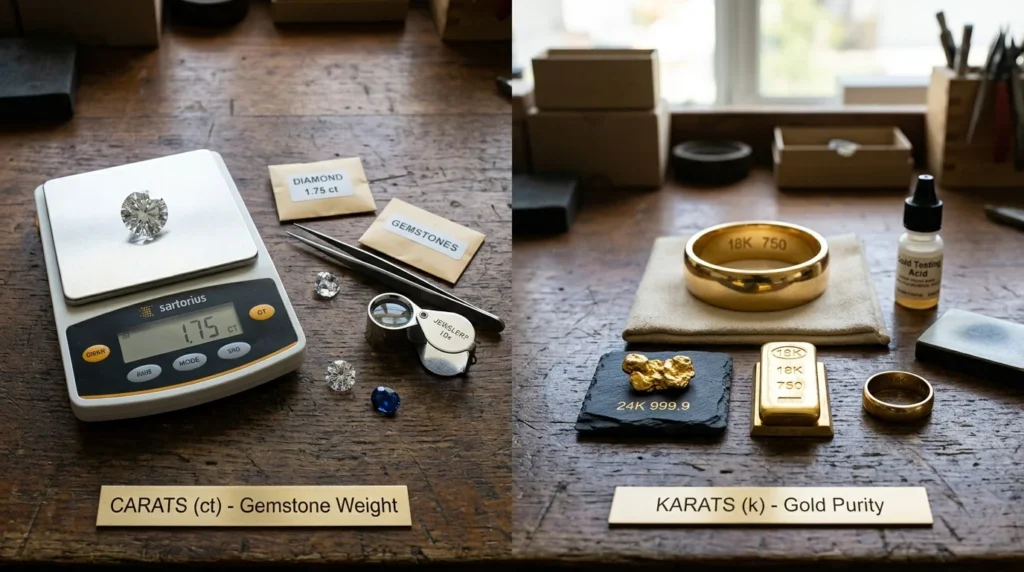
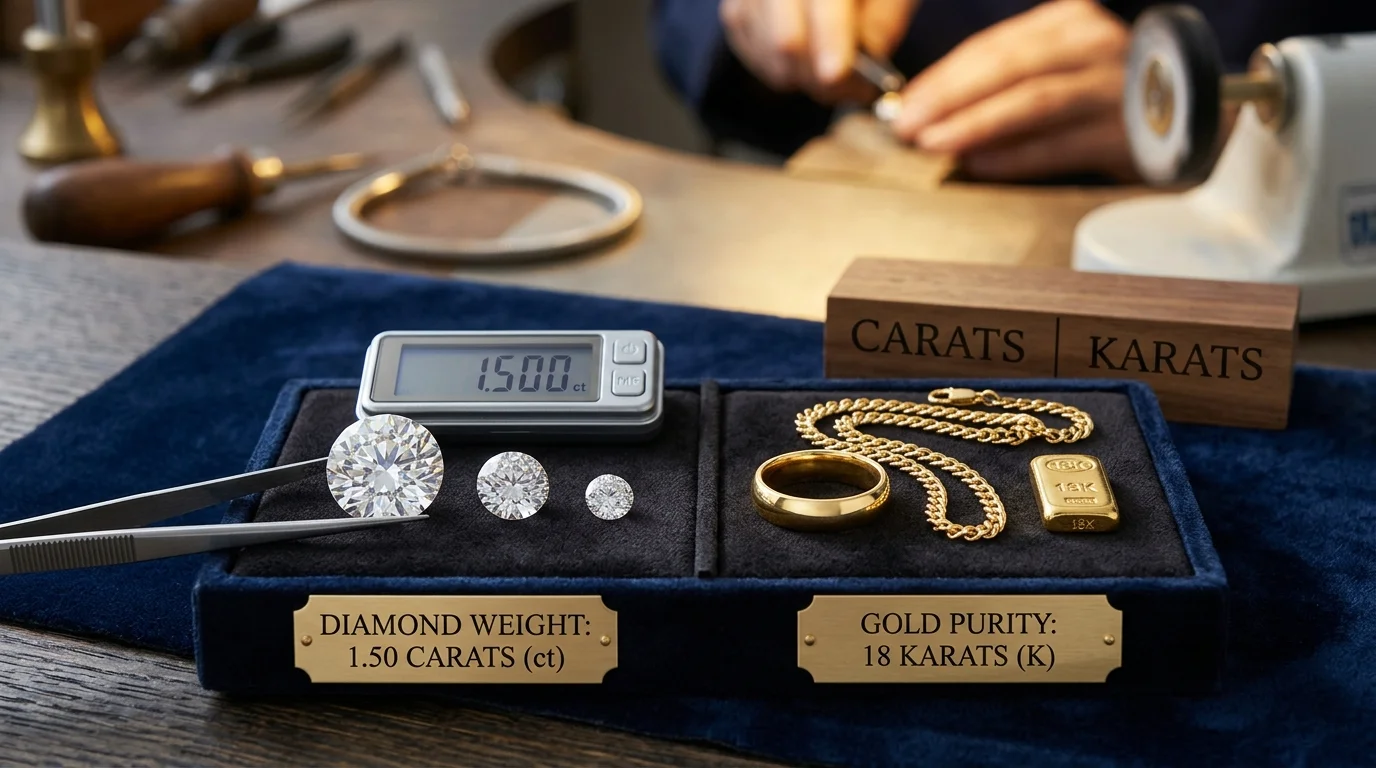
What Is “Carats”?
Carats is the plural form of carat. A carat is a unit of weight used for gemstones and diamonds.
One metric carat equals 200 milligrams, or 0.2 grams. Therefore, a gemstone weighing five carats has a mass of one gram.
The word is often abbreviated as ct in the jewelry industry.
What Does Carat Measure?
When discussing a diamond, ruby, sapphire, or another gemstone, carat usually refers to weight, not directly to quality.
For example:
“The diamond weighs two carats.”
This tells you the diamond’s weight. It does not, by itself, tell you how clear, well-cut, or valuable the stone is.
Diamond quality is commonly discussed using the 4Cs:
- Carat — weight
- Cut — how the stone is shaped and finished
- Color — the degree of color in a diamond
- Clarity — the presence of internal or external characteristics
A larger carat weight does not automatically mean a better-quality gemstone.
Examples of “Carats”
Here are some natural examples:
- “She chose a two-carat diamond.”
- “The ruby weighs three carats.”
- “This gemstone is less than one carat.”
- “The jeweler measured the stone at 1.5 carats.”
- “Carat weight is one factor used when evaluating a diamond.”
Grammar and Usage
Carat is singular:
“The stone weighs one carat.”
Carats is plural:
“The stones weigh three carats.”
When used before a noun, the singular form is normally used as a compound modifier:
“a two-carat diamond”
Not:
“a two-carats diamond”
This distinction is useful when writing product descriptions or jewelry content.
Regional Notes
The term carat is widely used internationally for gemstone weight, including in British English and American English.
However, the distinction between carat and karat becomes especially important when discussing gold purity in American English.
What Is “Karats”?
Karats is the plural form of karat. In the United States, karat is primarily used to describe the purity of gold.
Gold jewelry is often marked with numbers such as:
- 10K
- 14K
- 18K
- 24K
The K stands for karat.
What Does Karat Measure?
A karat indicates how much of a gold alloy consists of pure gold, based on a scale of 24 parts.
For example:
- 24K = very high-purity gold
- 18K = 18 parts gold out of 24
- 14K = 14 parts gold out of 24
- 10K = 10 parts gold out of 24
The remaining portion consists of other metals used to create the desired strength, color, or properties.
A simple calculation is:
Gold percentage = karat ÷ 24 × 100
So, 18K gold contains approximately 75% gold.
Examples of “Karats”
- “This ring is made from 18-karat gold.”
- “The necklace is available in 14K gold.”
- “The bracelet is marked 10K.”
- “Higher-karat gold generally contains more pure gold.”
- “The jeweler explained the difference between 14K and 18K gold.”
Grammar and Usage
Just like carat, the singular form is normally used in compound modifiers:
“an 18-karat gold ring”
You may also see the abbreviated form:
“an 18K gold ring”
When referring to multiple measurements generally, karats is the plural:
“The jewelry was available in several karats.”
Regional Notes
The spelling karat is especially common in American English when referring to gold purity.
In British English and some other varieties of English, carat may also be used for gold purity.
This regional difference is one of the most important points to remember when comparing carats or karats.
Key Differences Between Carats or Karats
The central difference is simple:
Carat = gemstone weight
Karat = gold purity
However, regional usage can make the distinction slightly more complicated.
Main Differences
- Carat commonly measures the weight of gemstones.
- Karat commonly measures the purity of gold in American English.
- One carat equals 200 milligrams.
- Karat is based on a 24-part gold-purity scale.
- Carat is widely used internationally for gemstones.
- Karat is particularly common in the United States for gold.
- A diamond’s carat weight does not directly measure its quality.
- A gold item’s karat number indicates its proportion of pure gold.
- British English may use carat for both gemstones and gold purity.
- The abbreviation for gemstone carat is commonly ct, while gold purity is commonly shown as K.
Comparison Table
| Feature | Carat | Karat |
|---|---|---|
| Main meaning | Gemstone weight | Gold purity |
| Common abbreviation | ct | K |
| Used for diamonds | Yes | No |
| Used for gold purity | In some regions | Yes, especially US English |
| Measurement basis | Weight | 24-part purity scale |
| One unit equals | 200 mg | 1/24 of the purity scale |
| Example | 2-carat diamond | 18-karat gold |
| US usage | Gemstone weight | Gold purity |
| UK usage | Gemstone weight and sometimes gold purity | Less common |
| Main field | Jewelry and gemstones | Gold and jewelry |
Carats or Karats: Why Are They So Confusing?
The confusion exists for a good reason: the words have the same historical origin and sound essentially the same.
Both terms developed from words associated with the carob seed, which was historically used in connections with weighing precious materials. Over time, different spelling conventions emerged for different uses and regions.
Modern English therefore has two forms that are closely related but generally serve different purposes.
If you are talking about a diamond’s weight, carat is the standard choice. If you are talking about gold purity in American English, karat is the standard choice.
Real-Life Conversation Examples
Dialogue 1: Buying a Diamond
Customer: How much does this diamond weigh?
Jeweler: It is 1.5 carats.
Customer: So the 1.5 refers to the gold purity?
Jeweler: No. Here, carats refer to the diamond’s weight.
🎯 Lesson: Use carats when discussing gemstone weight.
Dialogue 2: Choosing Gold
Customer: Is this ring 14 carats?
Jeweler: In American English, we’d normally say 14 karats or 14K for the gold purity.
Customer: Got it. Karat tells me about the gold.
🎯 Lesson: Karats commonly describe gold purity in US English.
Dialogue 3: Diamond and Gold Together
Customer: This ring says 18K and one carat. What does that mean?
Jeweler: The 18K describes the gold’s purity, while one carat describes the gemstone’s weight.
🎯 Lesson: A single piece of jewelry can correctly use both terms.
Dialogue 4: British Usage
Writer: Should I write “18 karat gold” for a British audience?
Editor: “18-carat gold” is also commonly used in British English.
🎯 Lesson: Regional English can affect the spelling used for gold purity.
Dialogue 5: Understanding Quality
Customer: Does a higher carat diamond always mean a better diamond?
Jeweler: Not necessarily. Carat measures weight, while other factors affect a diamond’s appearance and quality.
🎯 Lesson: Carat weight is only one part of evaluating a diamond.
When to Use Carats vs Karats
The easiest way to choose between carats or karats is to ask yourself one question:
Am I talking about gemstone weight or gold purity?
Use “Carat” for Gemstone Weight
Choose carat when describing the weight of a diamond or another gemstone.
Correct:
“She bought a one-carat diamond.”
Correct:
“The sapphire weighs two carats.”
Use “Karat” for Gold Purity
In American English, choose karat when describing gold purity.
Correct:
“The ring is made of 18-karat gold.”
Or simply:
“The ring is 18K.”
Memory Trick
Use this simple rule:
C = Carat = Crystal/Gemstone
Think of C as connecting carat with crystals and gemstones.
K = Karat = Gold
Think of K as the spelling commonly used for K gold in the United States.
So remember:
💎 Gemstone weight → Carat
🪙 Gold purity → Karat
US vs UK Rule
For an American audience:
- Diamond weight → carat
- Gold purity → karat
For a British audience:
- Diamond weight → carat
- Gold purity → carat is also commonly used
This means your target audience matters when choosing the spelling.
Common Mistakes to Avoid
Mistake 1: Saying a Diamond Is “18 Karats”
That would normally be incorrect if you are trying to describe its weight.
A diamond’s weight is measured in carats.
Mistake 2: Assuming Carat Means Quality
A diamond’s carat number describes weight, not its complete quality or value.
Two diamonds with the same carat weight can look different and have different prices.
Mistake 3: Ignoring Regional English
If your content targets American readers, karat is the expected spelling for gold purity.
For British readers, carat may be preferred for gold as well.
Mistake 4: Writing “Two-Carats Diamond”
When the measurement appears directly before a noun, use the singular form:
Correct: “a two-carat diamond”
Incorrect: “a two-carats diamond”
The same pattern applies to:
“an 18-karat ring.”
Why Understanding Carats or Karats Matters
The difference between carats or karats is more than a spelling issue. It can change the meaning of a jewelry description.
Imagine seeing a product listing that says a diamond is “two karats.” A knowledgeable reader may immediately recognize that the terminology is wrong or unclear.
Likewise, if someone describes gold as “24 carats” in American English, the meaning may be understood, but 24 karats is the conventional American spelling for gold purity.
Using the correct term makes product descriptions, educational content, jewelry advertisements, and conversations more precise.
For anyone working with jewelry, understanding these terms is especially valuable because weight and purity are completely different properties.
Fun Facts and History
💎 Fun Fact 1: Carat Is Connected to Carob
The word carat has historical connections to the Greek word keration, associated with the carob tree and its seeds. Carob seeds were once believed to have remarkably consistent weights, although modern research shows that their weights are not perfectly uniform.
The historical association nevertheless helped shape the terminology used for precious-material measurements.
🏆 Fun Fact 2: 24 Is the Key Number for Gold
The karat system divides gold purity into 24 parts. That’s why 24K represents the highest level on the traditional karat scale, while 18K represents 18 parts gold out of 24.
This makes the system easy to understand mathematically.
Quick Guide: Carats or Karats?
| What Are You Describing? | Correct Term |
|---|---|
| Diamond weight | Carat |
| Ruby weight | Carat |
| Sapphire weight | Carat |
| Gemstone weight | Carat |
| Gold purity in US English | Karat |
| 14K gold | Karat |
| 18K gold | Karat |
| 24K gold | Karat |
| Gold purity in British English | Carat may be used |
A useful final shortcut is:
Carat measures how much a gemstone weighs. Karat tells you how pure gold is.