
What Is CCD?
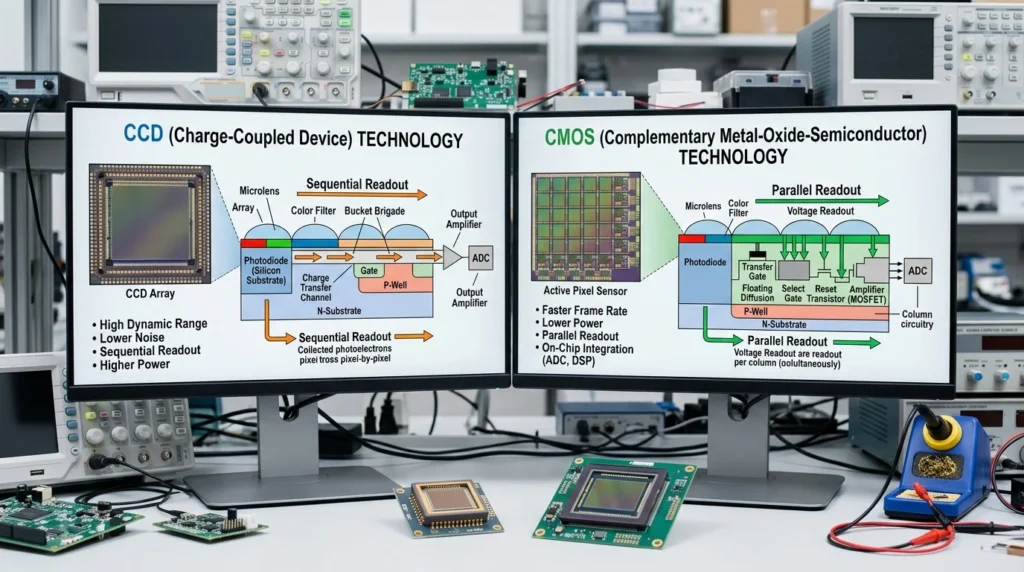
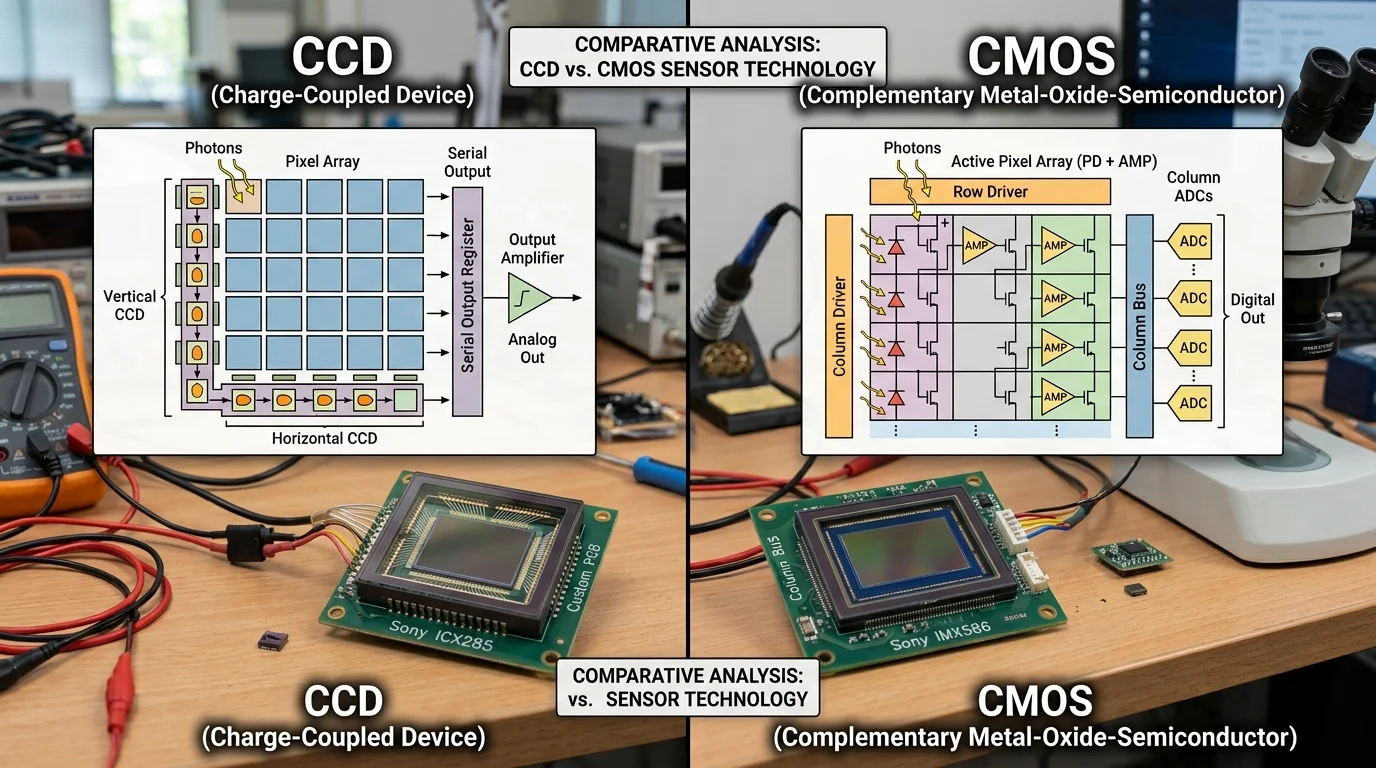
CCD stands for Charge-Coupled Device. It is an image-sensor technology that converts incoming light into electrical charges and transfers those charges across the sensor for processing.
CCD sensors were widely used in digital cameras and scientific imaging equipment before CMOS technology became dominant.
How CCD Works
When light reaches a CCD sensor, individual photosensitive elements collect electrical charge.
The stored charge is then transferred across the sensor in an organized sequence before being converted into a digital signal.
This architecture historically helped CCD sensors deliver:
- Consistent image quality
- Good image uniformity
- Low fixed-pattern noise
- Strong sensitivity in certain applications
Where CCD Is Used
CCD sensors have been used in:
- Scientific cameras
- Astronomy equipment
- Microscopes
- Industrial imaging
- Older digital cameras
- Specialized measurement systems
Short History of CCD
CCD technology was developed in the late 1960s and became an important foundation of early digital imaging.
For many years, CCD sensors were highly regarded for scientific and professional imaging. As CMOS technology improved, however, CMOS became increasingly attractive because of its speed, power efficiency, integration, and cost advantages.
What Is CMOS?
CMOS stands for Complementary Metal-Oxide-Semiconductor.
A CMOS image sensor uses photosensitive pixels along with electronics that allow signals to be processed efficiently within the sensor architecture.
CMOS technology is now widely used in modern imaging devices.
How CMOS Works
Each pixel in a CMOS sensor can have associated circuitry that helps read and process the electrical signal.
This architecture allows manufacturers to integrate additional electronics directly onto the sensor or nearby circuitry.
Modern CMOS sensors can provide:
- Fast readout
- Low power consumption
- High resolution
- Excellent image quality
- High frame rates
- Advanced autofocus features
Where CMOS Is Used
CMOS sensors are found in:
- Smartphones
- Digital cameras
- Mirrorless cameras
- DSLRs
- Webcams
- Security cameras
- Automotive cameras
- Industrial cameras
- Scientific imaging systems
Short History of CMOS
CMOS image sensors existed for decades, but improvements in manufacturing and sensor design eventually allowed them to compete strongly with CCD technology.
Modern CMOS sensors can provide image quality that was once associated primarily with CCD while also offering major advantages in speed, power efficiency, and integration.
CCD or CMOS: Key Differences
When comparing CCD or CMOS, the main differences come from how the sensor reads and processes the charge produced by light.
Key Differences
- CCD transfers charge across the sensor in a sequential process.
- CMOS uses pixel-level circuitry for more direct readout.
- CMOS generally uses less power.
- CMOS typically supports faster readout.
- CMOS is easier to integrate with additional electronics.
- CCD has historically been valued for image uniformity and low noise.
- Modern CMOS sensors can offer extremely high image quality.
- CMOS is much more common in modern consumer cameras.
- CCD remains useful for some specialized scientific and industrial applications.
- Sensor performance depends heavily on the specific design, not just CCD or CMOS.
Comparison Table
| Feature | CCD | CMOS |
|---|---|---|
| Full name | Charge-Coupled Device | Complementary Metal-Oxide-Semiconductor |
| Readout | Sequential charge transfer | Pixel-level electronic readout |
| Power consumption | Generally higher | Generally lower |
| Readout speed | Generally slower | Generally faster |
| Image quality | Historically excellent | Excellent in modern sensors |
| Noise | Historically very low | Very good to excellent |
| Integration | More specialized | Highly integrated |
| High frame rates | Less common | Very capable |
| Battery efficiency | Lower | Better |
| Modern consumer use | Limited | Dominant |
| Specialized imaging | Still used | Widely used |
Real-Life Conversation Examples
Dialogue 1: Buying a Camera
Emma: “Is CCD or CMOS better for a modern camera?”
Liam: “CMOS is generally the more common choice today because it’s fast, efficient, and capable of excellent image quality.”
🎯 Lesson: Modern cameras overwhelmingly favor CMOS technology.
Dialogue 2: Battery Life
Sarah: “I want a camera that uses less battery power.”
Tom: “CMOS sensors generally have an advantage in power efficiency.”
🎯 Lesson: CMOS is usually better when low power consumption matters.
Dialogue 3: Scientific Imaging
Mike: “Does CCD still have any advantages?”
Anna: “Yes. CCD technology remains useful in some specialized scientific and imaging applications.”
🎯 Lesson: CCD isn’t obsolete; specialized applications can still benefit from it.
Dialogue 4: Fast Video
Jack: “Which sensor is better for high-speed video?”
Alex: “CMOS generally has the advantage because of its fast readout capabilities.”
🎯 Lesson: CMOS is generally better suited to high-speed imaging.
When to Choose CCD
CCD can still make sense when you’re working with specialized equipment where characteristics such as:
- Image uniformity
- Specialized sensitivity
- Low noise
- Scientific measurement
- Established equipment compatibility
are important.
CCD is particularly relevant when replacing or maintaining an existing scientific or industrial imaging system.
For a new consumer camera, however, CCD is rarely the first choice.
When to Choose CMOS
CMOS is generally the better choice for modern applications involving:
- Photography
- Video
- Smartphones
- Webcams
- Security cameras
- High-speed imaging
- Battery-powered devices
- High-resolution cameras
Its combination of speed, efficiency, integration, and image quality makes it extremely versatile.
CCD or CMOS for Photography
For modern photography, CMOS is generally the preferred technology.
Modern CMOS sensors can deliver:
- High resolution
- Excellent dynamic range
- Strong low-light performance
- Fast autofocus
- High burst rates
- 4K and higher-resolution video
The quality of the camera depends on much more than the sensor type. Lens quality, sensor size, image processing, autofocus, and software all matter.
CCD or CMOS for Video
CMOS is generally the better choice for video.
Video requires a sensor to read many frames quickly, and modern CMOS designs can support high frame rates and fast data transfer.
This makes CMOS especially suitable for:
- 4K video
- High-frame-rate video
- Slow motion
- Live streaming
- Security cameras
CCD or CMOS for Low Light
This comparison is more complicated than simply saying one technology is better.
Older CCD sensors were famous for strong low-light performance, but modern CMOS sensors have improved dramatically.
Low-light performance depends on:
- Pixel size
- Sensor size
- Pixel design
- Read noise
- Dynamic range
- Image processing
- Lens aperture
A modern large CMOS sensor can outperform an older CCD sensor by a substantial margin.
CCD or CMOS for Astronomy
Both technologies have been used in astronomy.
CCD sensors historically played an important role in astronomical imaging because of their sensitivity and image characteristics.
Modern scientific CMOS, often called sCMOS, has become increasingly important because it can combine high sensitivity with fast readout.
For serious astronomical imaging, the specific sensor model matters more than simply choosing CCD or CMOS.
Common Mistakes
Mistake 1: Assuming CCD Is Always Better
CCD technology has an excellent historical reputation, but modern CMOS sensors have advanced enormously.
Mistake 2: Assuming CMOS Always Produces Better Images
Sensor design, size, optics, and processing all affect image quality.
Mistake 3: Comparing Only Megapixels
More megapixels don’t automatically mean better image quality.
Mistake 4: Ignoring Power Consumption
Battery-powered devices can benefit significantly from CMOS efficiency.
Mistake 5: Choosing Based Only on Technology Name
Two CMOS sensors can perform very differently, just as two CCD sensors can have different characteristics.
A Simple Memory Trick
Remember:
CCD → charge is coupled and transferred
CMOS → pixels have more direct electronic readout
For everyday modern cameras:
CMOS = speed + efficiency + integration
For specialized legacy and scientific applications:
CCD = established specialized imaging technology
Fun Facts or History
Fact 1: CMOS Became the Modern Standard
Although CCD once dominated many digital imaging applications, CMOS has become the dominant image-sensor technology in modern cameras and electronic devices.
Fact 2: Both Technologies Convert Light Into Electrical Signals
Despite their architectural differences, both CCD and CMOS sensors ultimately perform the same basic task: converting incoming photons into electrical information that can be processed into an image.