
What Is a Hernia?
A hernia occurs when an internal part of the body, such as fatty tissue or part of the intestine, pushes through a weak area in the surrounding muscle or tissue wall. Hernias can occur in several parts of the body, with groin and abdominal hernias among the commonly recognized types.
Common Hernia Symptoms
Depending on the type and location, symptoms can include:
- A bulge or lump
- Pressure or discomfort
- Aching or burning near the affected area
- Symptoms that become more noticeable with coughing, bending, lifting, or straining
For an inguinal hernia, the bulge may become more noticeable while standing and may become less obvious when lying down.
Not every hernia causes significant pain. Some people may notice a bulge without much discomfort.
What Causes a Hernia?
A hernia can develop when there is a weakness in the abdominal wall combined with increased pressure inside the abdomen. Factors associated with hernias can include strenuous activity, persistent coughing, and straining. Some weaknesses are also present from birth.
Important Point
A hernia is not the same thing as a pulled muscle. The problem involves tissue moving through a weakness in the surrounding wall rather than simply an injured muscle or tendon.
What Is a Strain?
A strain is an injury to a muscle or tendon. Tendons are strong tissues that connect muscles to bones. A strain can happen when a muscle or tendon is stretched beyond its normal limits or exposed to excessive force.
Strains are sometimes called pulled muscles.
Common Strain Symptoms
Depending on the severity, a strain may cause:
- Pain or tenderness
- Swelling
- Muscle weakness
- Limited movement
- Muscle spasms
- Discomfort when using the affected area
The exact symptoms depend on the muscle involved and how serious the injury is.
What Causes a Strain?
A strain can happen suddenly, such as during running, jumping, lifting, or another activity that places high demand on a muscle.
Strains can also develop gradually when the same movement repeatedly places stress on a muscle or tendon.
Example
Someone who suddenly changes direction during a sport may experience a muscle strain. Similarly, repeated activity can gradually irritate or overload a muscle or tendon.
Hernia or Strain: Key Differences
The biggest difference between hernia or strain is the structure affected.
- A hernia involves tissue pushing through a weak area in a body wall.
- A strain involves an injured muscle or tendon.
- A hernia may cause a visible or noticeable bulge.
- A strain more commonly causes pain, tenderness, swelling, weakness, or limited movement.
- Hernia symptoms can become more noticeable with coughing or straining.
- Strain symptoms often become worse when the affected muscle is used.
- Some hernias cause little or no pain.
- A strain usually relates to a specific muscle or tendon.
- Both can occur after physical activity.
- The symptoms can overlap, so a healthcare professional may be needed to tell them apart.
Comparison Table
| Feature | Hernia | Strain |
|---|---|---|
| Main problem | Tissue pushes through a weak area | Muscle or tendon injury |
| Common trigger | Increased pressure or existing weakness | Stretching or overuse |
| Bulge | May occur | Not typical |
| Pain | May or may not occur | Common |
| Tenderness | Can occur | Common |
| Swelling | Possible | Possible |
| Muscle weakness | Not the defining feature | Common |
| Coughing/straining effect | May make bulge or discomfort more noticeable | May increase pain depending on location |
| Treatment | Depends on type and severity | Often involves activity modification and rehabilitation |
| Diagnosis | Physical examination, sometimes imaging | Examination, sometimes imaging |
Hernia or Strain: Why They Get Confused
The hernia or strain question often comes up because both problems can appear after physical activity.
For example, someone might lift something and then notice discomfort in the groin or abdominal area.
That doesn’t automatically mean the activity caused one particular condition.
A muscle strain can result directly from excessive force placed on a muscle or tendon. A hernia, on the other hand, involves a weakness in a body wall through which tissue protrudes, with increased abdominal pressure potentially contributing.
Because the symptoms can overlap, trying to diagnose the condition from the activity alone isn’t reliable.
Hernia or Strain: Location of Pain
Location can provide clues, but it cannot establish a diagnosis by itself.
Hernia
An inguinal hernia often occurs around the groin, including the area near the pubic bone. It may cause discomfort, pressure, or a noticeable bulge.
Strain
A strain can happen in many muscles, including muscles around the:
- Groin
- Hip
- Thigh
- Back
- Shoulder
- Arm
Groin strains are common in sports and can produce pain in the groin or inner-thigh region.
This is why location alone cannot reliably distinguish a hernia from a strain.
Hernia or Strain: The Importance of a Bulge
One of the more useful clues in the hernia or strain comparison is whether there is a noticeable bulge.
A groin hernia can produce a lump or bulge that may become more visible when standing, coughing, or straining. It may become less noticeable while lying down.
A typical muscle strain does not create a bulge caused by internal tissue pushing through a body-wall weakness.
However, swelling can occur with a muscle injury, which means a swollen area should not automatically be assumed to be a hernia.
If you notice a new lump or bulge, particularly in the groin or abdomen, professional medical assessment is appropriate.
Hernia or Strain After Exercise
Physical activity can be involved in both conditions, but the mechanisms are different.
Strain After Exercise
A muscle strain may happen during:
- Sprinting
- Jumping
- Sudden movements
- Lifting
- Sports
- Repetitive activities
Mayo Clinic notes that acute strains can occur from sudden events such as lifting something improperly or sprinting.
Hernia After Physical Activity
Heavy lifting or strenuous activity can increase pressure inside the abdomen. If there is a weak area in the abdominal wall, tissue can push through that area and create a hernia.
This means that saying “the pain started after exercise” does not by itself distinguish between a hernia and strain.
Hernia or Strain: Pain Patterns
Pain can provide useful information, but it is not enough for a diagnosis.
Hernia Pain
A hernia may produce:
- Aching
- Burning
- Pressure
- Discomfort during lifting
- Symptoms associated with coughing or bending
Some hernias may not hurt at all.
Strain Pain
A strain commonly produces:
- Localized pain
- Tenderness
- Discomfort when using the injured muscle
- Weakness
- Limited movement
The severity depends on how much the muscle or tendon has been injured.
Hernia or Strain: Real-Life Conversation Examples
Conversation 1: Pain After Sports
Alex: “My groin started hurting after playing sports.”
Sam: “A muscle strain is one possibility, but groin pain can have several causes.”
🎯 Lesson: Groin pain does not automatically mean a strain or hernia.
Conversation 2: Noticeable Bulge
Alex: “I noticed a new lump in my groin that becomes more obvious when I cough.”
Sam: “That can be a sign of a hernia and should be evaluated by a healthcare professional.”
🎯 Lesson: A cough-related bulge is an important reason to seek medical assessment.
Conversation 3: Muscle Tenderness
Alex: “The area is sore when I move the muscle, and it started after a sudden movement.”
Sam: “That pattern can occur with a muscle strain.”
🎯 Lesson: Sudden movement followed by localized muscle pain can fit a strain pattern.
Conversation 4: Uncertain Symptoms
Alex: “I can’t tell whether it’s a hernia or strain.”
Sam: “Because the symptoms can overlap, a healthcare professional can examine the area and determine what needs to be checked.”
🎯 Lesson: Self-diagnosis can be unreliable when symptoms overlap.
When to Seek Medical Advice
If you think you may have a hernia, it is a good idea to have it assessed by a healthcare professional. The NHS specifically advises people to seek medical advice if they think they have a hernia.
A new or noticeable groin bulge deserves attention, especially if it is painful or becoming larger.
For a suspected strain, medical evaluation is also appropriate when pain is severe, symptoms are worsening, movement is significantly limited, or symptoms aren’t improving. Mayo Clinic recommends medical assessment for worsening or serious strain symptoms and when there is significant difficulty using the affected muscle.
Urgent Warning Signs
A hernia can occasionally develop a serious complication. Seek urgent medical care if a hernia bulge becomes discolored or if there is sudden worsening pain accompanied by symptoms such as nausea, vomiting, fever, or difficulty passing stool or gas.
These symptoms can indicate that tissue has become trapped and its blood supply may be affected.
How Is a Hernia Diagnosed?
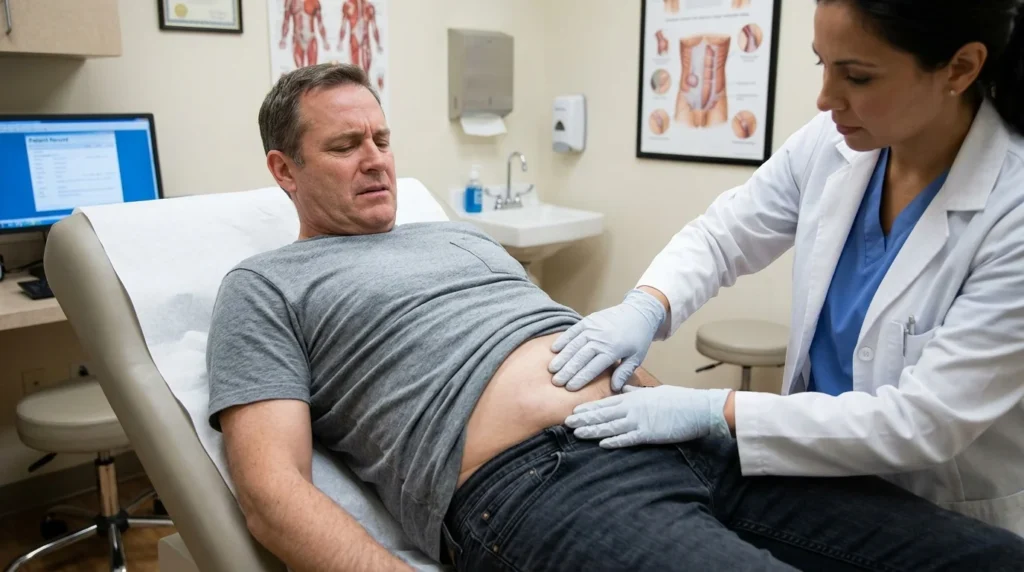
A healthcare professional can often diagnose an inguinal hernia through a physical examination.
The examination may involve checking the groin while the person is standing and asking them to cough or strain, because these actions can make a hernia more noticeable.
If the diagnosis isn’t clear, imaging such as an ultrasound, CT scan, or MRI may sometimes be used.
The appropriate evaluation depends on the suspected type of hernia and the person’s symptoms.
How Is a Strain Diagnosed?
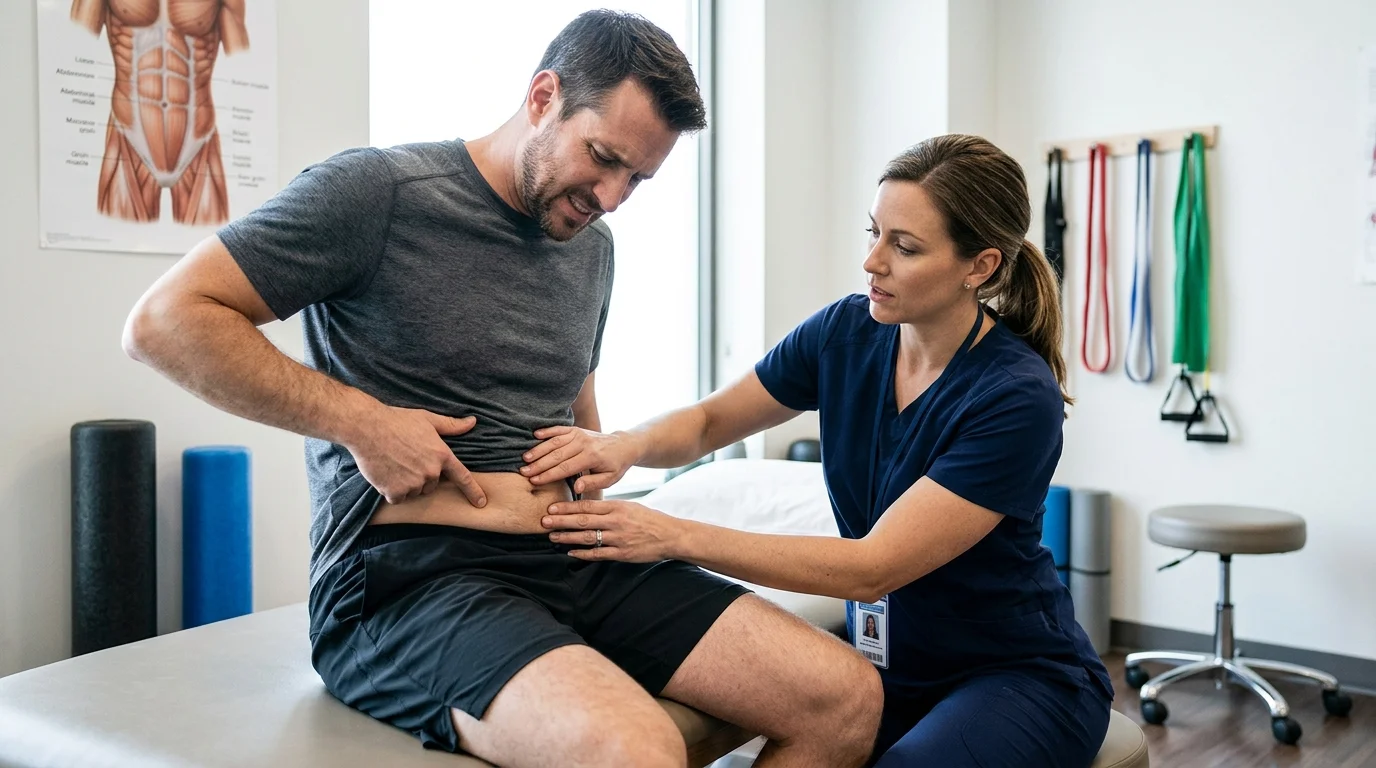
A muscle strain is usually assessed through a physical examination.
A healthcare professional may check:
- Where the pain is located
- Tenderness
- Swelling
- Movement
- Muscle strength
- How the injury occurred
Mayo Clinic notes that ultrasound can sometimes help distinguish different soft-tissue injuries when more information is needed.
The medical history is also useful because the timing and activity associated with the injury can provide important clues.
Treatment Differences
The treatment for a hernia or strain can be very different.
Hernia
Treatment depends on the type, size, symptoms, and individual circumstances.
Some small hernias that aren’t causing problems may be monitored by a healthcare professional. Painful or enlarging inguinal hernias may require surgical repair.
Strain
Mild muscle strains are often managed with protection of the injured area, rest from activities that worsen symptoms, and gradual rehabilitation. Mayo Clinic describes a P.R.I.C.E. approach for initial strain care and notes that physical therapy may help restore strength and stability.
More serious strains can require professional treatment and, in some severe cases, surgery.
Hernia or Strain: Can One Look Like the Other?
Yes, symptoms can overlap.
Groin pain is particularly challenging because muscle or tendon strains are common causes of groin pain, but hernias and other conditions can also cause similar symptoms.
A condition sometimes called a sports hernia adds additional confusion. Despite its name, it is generally described as a core muscle injury involving the lower abdominal wall or tendons around the pelvis, rather than a conventional intestinal hernia with a typical protruding bulge.
That is why a healthcare professional may need to evaluate persistent or unclear groin pain.
Common Mistakes
Mistake 1: Assuming All Groin Pain Is a Hernia
Groin pain has many possible causes, and muscle strains are common.
Mistake 2: Assuming Exercise Always Causes a Strain
A hernia can also become noticeable after activities that increase abdominal pressure.
Mistake 3: Ignoring a New Bulge
A noticeable groin or abdominal bulge should be professionally assessed.
Mistake 4: Diagnosing Yourself From Pain Alone
Pain location and severity can overlap between conditions.
Mistake 5: Returning to Activity Too Quickly
Continuing an activity that worsens a suspected muscle injury can delay recovery or make symptoms worse. Mayo Clinic recommends avoiding activities that cause pain, swelling, or discomfort during early strain care.
Hernia or Strain: Prevention
There is no single way to prevent every hernia or strain, but some general habits can reduce certain risks.
For Muscle Strains
Gradually prepare your body for demanding activities. Regular conditioning, appropriate strengthening, and flexibility work can help reduce strain risk.
Avoid making sudden major increases in physical activity.
For Hernias
Some causes of hernias, particularly structural weaknesses, cannot simply be prevented. Factors that increase abdominal pressure can contribute to some hernias, so addressing ongoing issues such as persistent coughing or difficult bowel movements may be relevant.
Hernia or Strain: Quick Decision Guide
| Sign or Situation | May Suggest |
|---|---|
| New groin or abdominal bulge | Hernia |
| Bulge more noticeable when coughing | Hernia |
| Pain after sudden muscle movement | Strain |
| Local muscle tenderness | Strain |
| Muscle weakness | Strain |
| Pain with certain muscle movements | Strain |
| Pressure or aching around a known bulge | Hernia |
| Persistent unexplained groin pain | Needs professional evaluation |
| Severe or rapidly worsening symptoms | Seek urgent medical care |