

What Is “Kneed”?
Kneed is the past tense and past participle of the verb knee.
As a verb, knee means to strike someone or something with the knee.
For example:
He kneed the ball away from the opponent.
The player kneed the ball toward the goal.
The word can also refer to striking a person with the knee, although that usage should be understood simply as a description of an action.
Kneed as a Verb
The basic forms are:
knee → kneed → kneeing
Examples:
He kneed the ball.
She was kneed during the match.
The player is kneeing the ball forward.
The spelling kneed contains the word knee, which makes its meaning easier to remember.
Important Note
Kneed is relatively uncommon compared with ordinary uses of the word knee. You’ll most often encounter it in descriptions of sports, physical actions, or situations involving striking with the knee.
What Is “Knead”?
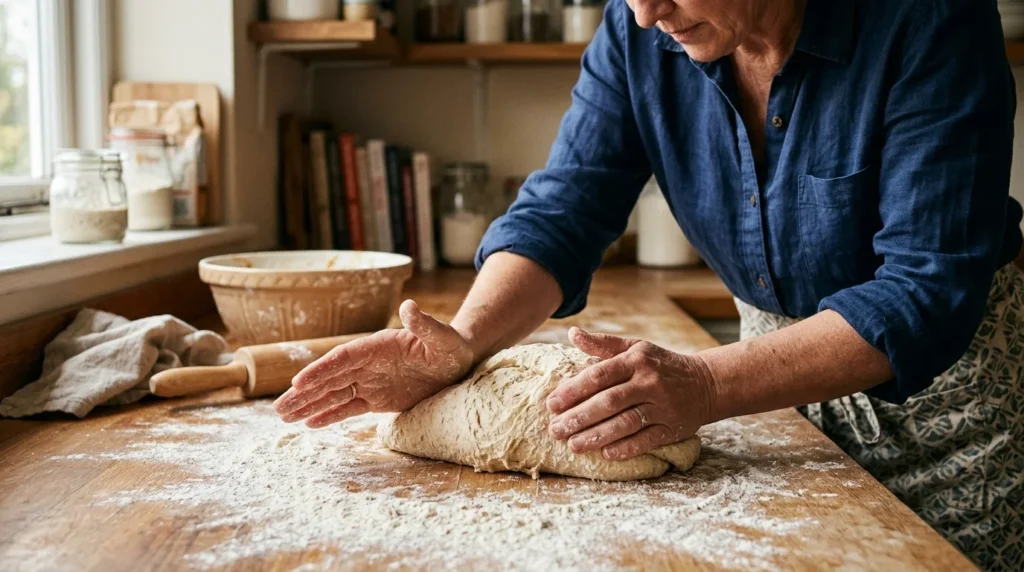
Knead is a verb that means to work dough by pressing, folding, and stretching it repeatedly, usually by hand.
For example:
Knead the dough for ten minutes.
She kneaded the bread dough until it became smooth.
This is the word you need in cooking and baking.
Knead in Baking
Kneading is an important part of making many types of bread.
When dough is kneaded, repeated movements help develop its structure. This can make the dough smoother and more elastic.
Common phrases include:
- knead the dough
- knead the mixture
- knead by hand
- knead until smooth
- knead for five minutes
Knead Beyond Cooking
Knead can also be used more broadly for pressing or working something repeatedly.
For example:
She kneaded the clay into shape.
It can also appear figuratively or in descriptions of massage-like pressure, although the cooking meaning is by far the most familiar.
Kneed or Knead: Key Differences
The main difference between kneed or knead is their meaning and spelling, even though they have the same pronunciation.
- Kneed comes from the verb knee.
- Knead means to work dough or another material by pressing and folding it.
- Kneed is usually associated with a physical action involving the knee.
- Knead is strongly associated with baking and cooking.
- Both words are verbs.
- Both are pronounced the same.
- Kneed contains the spelling of knee.
- Knead contains -nead, which is unrelated to the body part.
Comparison Table
| Feature | Kneed | Knead |
|---|---|---|
| Word type | Verb | Verb |
| Meaning | Struck with the knee | Worked dough or material |
| Base word | Knee | Knead |
| Common context | Sports or physical action | Cooking and baking |
| Pronunciation | Same as “knead” | Same as “kneed” |
| Example | He kneed the ball. | Knead the dough. |
| Past tense | Kneed | Kneaded |
| Main clue | Knee | Dough |
Kneed or Knead: Pronunciation
One of the reasons kneed or knead causes confusion is that the words are homophones.
They are generally pronounced the same:
kneed = /niːd/
knead = /niːd/
They sound like the word “need.”
So if someone says:
“I need to knead the dough.”
the words need and knead sound alike.
Similarly:
“He kneed the ball.”
contains a word that sounds identical to knead.
Since pronunciation doesn’t help you distinguish them, you need to use context and spelling.
Kneed or Knead in Cooking
When you’re talking about bread, pizza dough, rolls, or other dough-based recipes, use knead.
Correct:
Knead the dough for eight minutes.
Incorrect:
Kneed the dough for eight minutes.
The second sentence accidentally says something related to striking with a knee.
Common Cooking Examples
Knead the dough until it becomes smooth.
After mixing the ingredients, knead the dough for several minutes.
You can knead the dough by hand.
Knead gently until the ingredients are combined.
Whenever you’re working dough, remember:
Knead = baking
Kneed or Knead in Sports
When describing an action involving someone’s knee, use kneed.
For example:
The player kneed the ball.
He kneed the ball into position.
Here, kneed comes from knee, so the meaning is connected to the body part.
This is completely different from:
Knead the dough.
Easy Comparison
Kneed → knee
Knead → dough
That’s one of the simplest ways to separate the two.
Kneed or Knead: Real-Life Conversation Examples
Conversation 1: Baking
Alex: “What should I do after mixing the dough?”
Sam: “Knead it until it becomes smooth.”
🎯 Lesson: Use knead when working dough.
Conversation 2: Sports
Alex: “What happened to the ball?”
Sam: “The player kneed it toward the goal.”
🎯 Lesson: Use kneed when the knee is used to strike or move something.
Conversation 3: Common Spelling Mistake
Alex: “The recipe says to kneed the dough.”
Sam: “It should say knead the dough.”
🎯 Lesson: Baking instructions use knead, not kneed.
Conversation 4: Remembering the Difference
Alex: “How do I remember which one is correct?”
Sam: “Think knee for kneed and dough for knead.”
🎯 Lesson: Connecting each spelling with its meaning makes the difference easy to remember.
When to Use Kneed or Knead
Use kneed when the sentence describes using the knee to strike, push, or move something.
Examples:
He kneed the ball.
The athlete kneed the ball forward.
Use knead when you’re working dough or another material by pressing, folding, or squeezing it.
Examples:
Knead the dough thoroughly.
She kneaded the clay into shape.
Easy Memory Trick
Remember the first part:
KNEED = KNEE
If you can physically connect the action to your knee, use kneed.
For cooking:
KNEAD = DOUGH
If you’re preparing bread dough, use knead.
This simple association solves most kneed or knead spelling problems.
Kneed vs. Kneaded
Another useful point is the difference between kneed and kneaded.
Kneed is the past tense of knee:
He kneed the ball.
Kneaded is the past tense of knead:
She kneaded the dough.
Compare them:
| Base Verb | Past Tense | Example |
|---|---|---|
| Knee | Kneed | He kneed the ball. |
| Knead | Kneaded | She kneaded the dough. |
The added -ed in kneaded makes the baking word easier to recognize.
Common Mistakes
Mistake 1: Using Kneed in a Recipe
Incorrect:
Kneed the dough for five minutes.
Correct:
Knead the dough for five minutes.
Mistake 2: Using Knead for a Knee Action
Incorrect:
He knead the ball.
Correct:
He kneed the ball.
Mistake 3: Confusing Them Because They Sound the Same
Both words are pronounced the same, so spelling must come from the context.
Mistake 4: Confusing Knead With Need
Need is another homophone.
Compare:
I need some flour.
Knead the dough.
He kneed the ball.
All three can sound alike at the beginning or entirely, depending on the sentence, but their meanings are completely different.
Kneed, Knead, or Need?
This three-way comparison is particularly useful.
Need
Need means to require something.
I need more flour.
Knead
Knead means to work dough.
Knead the flour and water together.
Kneed
Kneed means to strike or move something with the knee.
He kneed the ball.
Comparison
| Word | Meaning | Example |
|---|---|---|
| Need | Require something | I need water. |
| Knead | Work dough | Knead the dough. |
| Kneed | Use the knee | He kneed the ball. |
This is a perfect example of why context matters in English spelling.
Kneed or Knead in Formal Writing
In formal writing, using the correct spelling is especially important.
A recipe should say:
Knead the dough until smooth.
A sports report might say:
The player kneed the ball across the field.
Using the wrong word can completely change the meaning or make the sentence sound incorrect.
Because kneed or knead are homophones, proofreading is particularly important when using speech-to-text software or writing quickly.
Kneed or Knead in American and British English
There is no meaningful US vs. UK spelling difference between kneed and knead.
Both American and British English use:
- kneed
- knead
- kneaded
For example:
American English:
Knead the dough until smooth.
British English:
Knead the dough until smooth.
The spelling is identical.
Grammar Forms of Kneed
The verb knee has these forms:
Base: knee
Past: kneed
Past participle: kneed
-ing form: kneeing
Examples:
He knees the ball.
He kneed the ball.
He has kneed the ball.
He is kneeing the ball.
The word kneed is therefore a normal past-tense form.
Grammar Forms of Knead
The verb knead follows a regular verb pattern:
Base: knead
Past: kneaded
Past participle: kneaded
-ing form: kneading
Examples:
She kneads the dough.
She kneaded the dough.
She has kneaded the dough.
She is kneading the dough.
This difference can help when choosing the correct form.
Why Do Kneed and Knead Sound the Same?
English contains many homophones because spelling and pronunciation developed through different historical influences.
Some words retained older spellings even though their pronunciation changed over time.
The k in knee is silent, and the same spelling pattern appears in knead.
That’s why:
kneed
and
knead
are pronounced alike.
This isn’t unusual in English. Other examples include:
- know / no
- right / write
- flour / flower
- sea / see
Fun Facts or History
Fun Fact 1: Knead Is Related to Old Germanic Words
The English verb knead has old Germanic roots connected with pressing or working dough and related materials.
Fun Fact 2: The K in Knee Is Silent
The word knee once had a pronounced initial consonant in earlier forms of English. Over time, pronunciation changed while the spelling retained the k.
That same silent-letter pattern appears in words such as knead and knock.
Is kneed the past tense of knee?
Yes.
He kneed the ball.
What is the past tense of knead?
The past tense is kneaded.
She kneaded the dough.
What is the difference between knead and need?
Need means to require something, while knead means to work dough or another material.
How do I remember kneed vs. knead?
Think:
KNEED = KNEE
KNEAD = DOUGH
Is there a British and American difference?
No significant spelling difference exists. Both varieties use kneed and knead in the same way.
Quick Guide: Kneed or Knead?
| Situation | Correct Word |
|---|---|
| Work bread dough | Knead |
| Work pizza dough | Knead |
| Press and fold dough | Knead |
| Work clay | Knead |
| Strike with the knee | Kneed |
| Move a ball using the knee | Kneed |
| Past tense of knee | Kneed |
| Past tense of knead | Kneaded |
| Require something | Need |
The Simplest Rule
When you’re deciding between kneed or knead, remember one simple association:
Kneed → Knee
Knead → Dough
For example:
He kneed the ball.
Knead the dough.
And don’t forget the third homophone:
I need some flour.
Once you connect each spelling with its meaning, these three words become much easier to distinguish.