
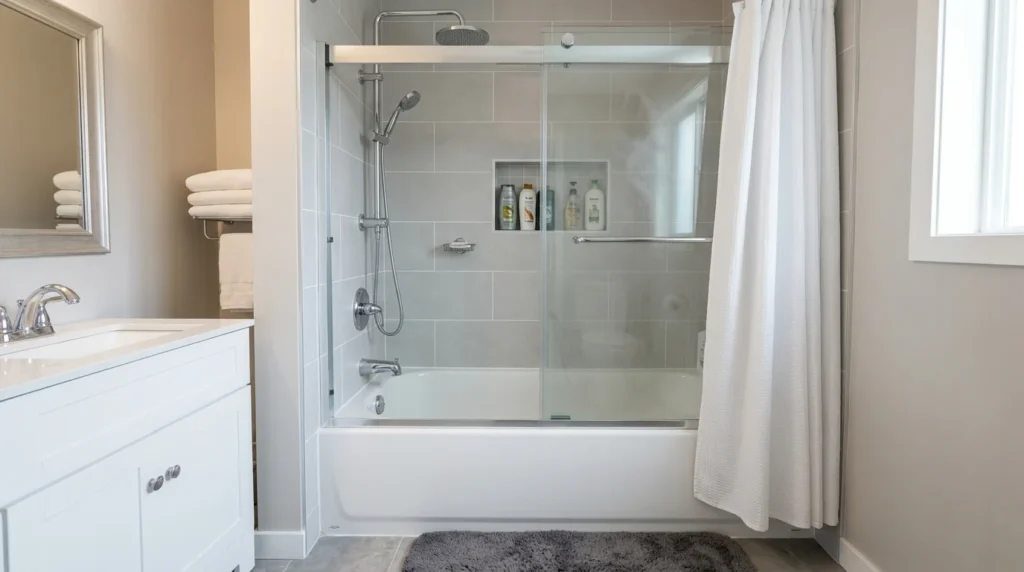
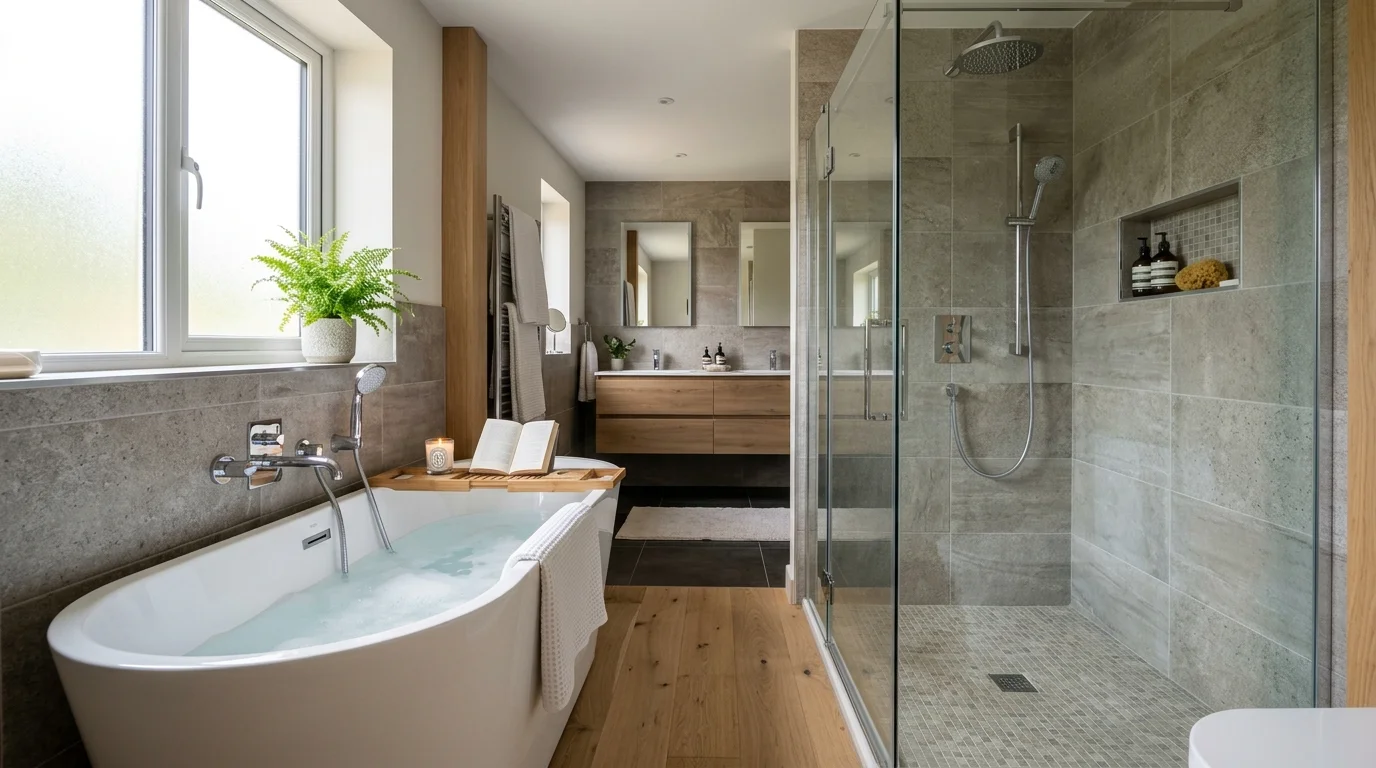
What Is a Tub?
A tub, short for bathtub, is a bathroom fixture designed to hold water for bathing.
A person typically fills the tub with water and sits or reclines inside it.
Common Types of Tubs
Bathtubs come in several styles, including:
- Freestanding tubs
- Alcove tubs
- Drop-in tubs
- Corner tubs
- Soaking tubs
- Tub-and-shower combinations
Main Uses
A tub is commonly used for:
- Taking baths
- Relaxing
- Bathing children
- Soaking
- Personal hygiene
Example Sentence
“The bathroom has a large tub that’s ideal for taking a relaxing bath.”
A tub generally requires more water and time than a typical shower, although usage varies considerably.
What Is a Shower?
A shower is a bathroom fixture that sprays water over the person while the water drains away.
Unlike a bathtub, a shower doesn’t normally require the user to sit in standing water.
Common Types of Showers
You may encounter:
- Walk-in showers
- Enclosed showers
- Corner showers
- Handheld showers
- Rain showers
- Tub-and-shower combinations
Main Uses
Showers are commonly used for:
- Daily bathing
- Quick washing
- Hair washing
- Personal hygiene
- Efficient water use
Example Sentence
“I usually take a quick shower before school.”
Showers are often considered convenient because they can be faster than filling and using a bathtub.
Tub or Shower: Key Differences
When comparing tub or shower, the biggest differences involve bathing style, time, space, and water use.
- A tub holds water for bathing.
- A shower continuously sprays water while draining it.
- Tubs are often associated with relaxation.
- Showers are often associated with speed and convenience.
- Tubs can be useful for bathing young children.
- Showers can be easier to access for some people, especially when designed with accessibility features.
- A tub generally requires more bathroom floor and vertical space than a basic shower installation.
- Both can be installed together in a tub-and-shower combination.
- Water consumption depends on the fixture, duration, and personal habits.
Comparison Table
| Feature | Tub | Shower |
|---|---|---|
| Main purpose | Bathing/soaking | Washing/rinsing |
| Water setup | Holds water | Water runs continuously to drain |
| Typical experience | Relaxing | Quick and practical |
| Time | Usually longer | Often faster |
| Space | Can require more space | Can fit compact designs |
| Child bathing | Often convenient | Less convenient for some children |
| Accessibility | Depends on design | Walk-in designs can be highly accessible |
| Cleaning | Requires cleaning the basin | Requires cleaning walls/floor/drain |
| Common installation | Bathtub or combination | Standalone shower or combination |
Real-Life Conversation Examples
Dialogue 1: Quick Morning Routine
Person 1: “I don’t have much time in the morning.”
Person 2: “A shower may be more convenient for a quick wash.”
🎯 Lesson: Showers are often preferred when speed matters.
Dialogue 2: Relaxation
Person 1: “I want somewhere to relax after a long day.”
Person 2: “A bathtub might be a better choice.”
🎯 Lesson: Tubs can provide a more relaxing soaking experience.
Dialogue 3: Small Bathroom
Person 1: “My bathroom is pretty small.”
Person 2: “A compact shower could make better use of the available space.”
🎯 Lesson: Bathroom dimensions can influence the best choice.
Dialogue 4: Both Options
Person 1: “Do I have to choose between them?”
Person 2: “Not necessarily. A tub-and-shower combination can give you both options.”
🎯 Lesson: A combination installation can provide flexibility.
When to Choose a Tub or Shower
Choose a Tub If You Value Soaking
A tub may be a good choice if you enjoy:
- Taking baths
- Relaxing in warm water
- Bathing children
- Having a versatile bathroom fixture
A tub can also provide the option of adding a shower above it.
Choose a Shower If You Value Convenience
A shower may be preferable if you want:
- Faster bathing
- Easy daily use
- A modern walk-in design
- Efficient use of bathroom space
- Accessibility-focused features
The right choice ultimately depends on your household’s needs.
Tub or Shower for Small Bathrooms
Bathroom size can make a major difference.
A large freestanding tub may require substantial floor space.
A well-designed shower can sometimes fit into a smaller footprint.
However, dimensions vary greatly between fixtures, so it’s important to measure the available area before choosing a design.
For very small bathrooms, a compact shower or tub-shower combination can be practical.
Tub or Shower for Families
Families may prefer having a tub because it can make bathing young children easier.
A combination unit can provide both:
- A bathtub for children or relaxing baths
- A shower for quick adult bathing
For households with different preferences, a combination may therefore offer greater flexibility.
Tub or Shower and Water Use
Water consumption depends heavily on how long you bathe and how much water your fixture uses.
A long shower can use more water than a short bath, while a long bath can use more water than a short shower.
Therefore, it’s inaccurate to say that one option always uses less water.
If water efficiency matters to you, consider:
- Shower duration
- Fixture flow rate
- Tub capacity
- How full you fill the tub
- Water-saving fixtures
Tub or Shower Maintenance
Both fixtures require regular cleaning.
Tub Maintenance
A tub may need cleaning around:
- The basin
- Drain
- Faucet
- Caulking
- Surrounding walls
Shower Maintenance
A shower may require attention to:
- Floor
- Drain
- Glass doors
- Walls
- Fixtures
- Caulking
Regular cleaning can help prevent buildup and keep the bathroom comfortable and hygienic.
Tub or Shower for Accessibility
Accessibility depends heavily on the design rather than simply choosing a tub or shower.
A walk-in shower can be designed with features such as:
- Low thresholds
- Grab bars
- Built-in seating
- Handheld showerheads
- Slip-resistant surfaces
A standard bathtub can be more difficult for some people to enter and exit safely.
If accessibility is a priority, the bathroom should be designed around the user’s specific mobility needs.
Common Mistakes
Mistake 1: Assuming Showers Always Save More Water
Water use depends on shower length and fixture flow rate.
Mistake 2: Choosing Based Only on Appearance
A beautiful bathroom still needs to be practical.
Consider how you actually use the space.
Mistake 3: Ignoring Bathroom Size
Always measure the available area before selecting a fixture.
Mistake 4: Forgetting Accessibility
Think about how easily everyone who uses the bathroom can enter, exit, and operate the fixture.
Mistake 5: Assuming You Must Choose One
A tub-shower combination can provide both bathing options.
Fun Facts or History
1. Bathtubs Have a Long History
Bathing in large containers and dedicated bathing spaces has existed in many cultures for centuries.
2. Modern Showers Became Increasingly Practical
Advances in indoor plumbing and water systems helped make showers a common feature of modern homes.