
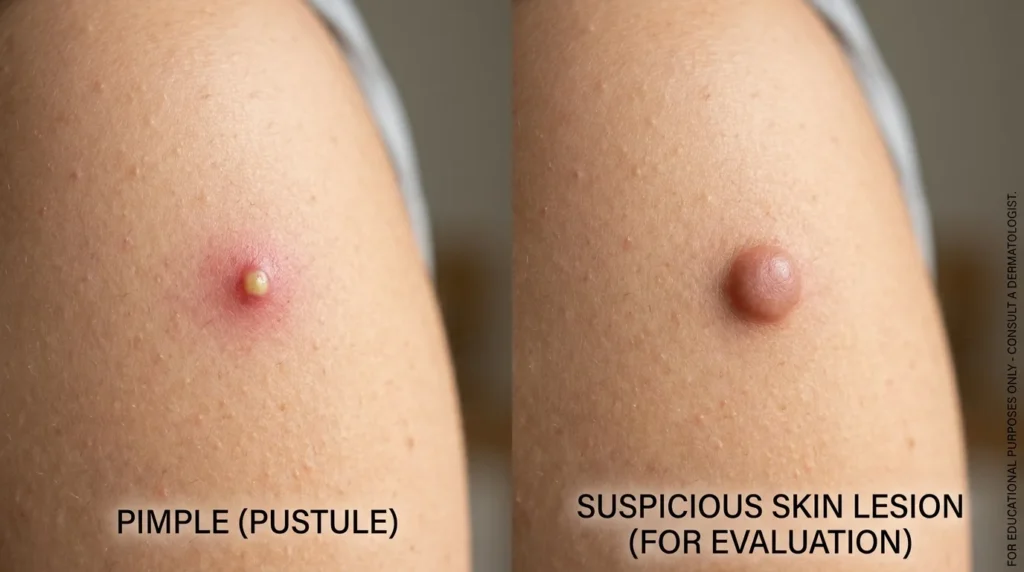
What Is a Pimple?
A pimple is a common type of acne lesion that develops when a hair follicle becomes clogged with oil, dead skin cells, and other material. Bacteria and inflammation can contribute to the development of acne.
Pimples can appear on the:
- Face
- Forehead
- Chest
- Back
- Shoulders
They may appear as small red bumps, whiteheads, blackheads, or inflamed spots.
What Causes Pimples?
Several factors can contribute to acne, including:
- Excess oil production
- Dead skin cells
- Clogged hair follicles
- Hormonal changes
- Inflammation
- Certain medications or products
A pimple may sometimes become tender, especially when inflammation is present.
How Long Does a Pimple Last?
Many ordinary pimples gradually improve over days or weeks. The exact duration depends on the type and severity of the acne.
A pimple that changes, heals, and eventually disappears is generally different from a persistent lump that remains unchanged or continues growing.
Example Sentences
- “I have a small pimple on my forehead.”
- “The pimple became red and tender.”
- “This acne spot is gradually getting smaller.”
What Is a Tumor?
A tumor is an abnormal mass or growth of cells. Tumors can be benign (noncancerous) or malignant (cancerous).
Importantly, the word tumor does not automatically mean cancer.
Tumors can develop in many different parts of the body, including organs and tissues. Some can also occur in or under the skin.
Benign vs. Malignant Tumors
A benign tumor does not behave like cancer and generally does not invade nearby tissues or spread to distant parts of the body.
A malignant tumor, on the other hand, is cancerous and can invade surrounding tissue or spread to other parts of the body.
The distinction between a harmless growth and a concerning one often requires a medical evaluation.
Can a Tumor Look Like a Pimple?
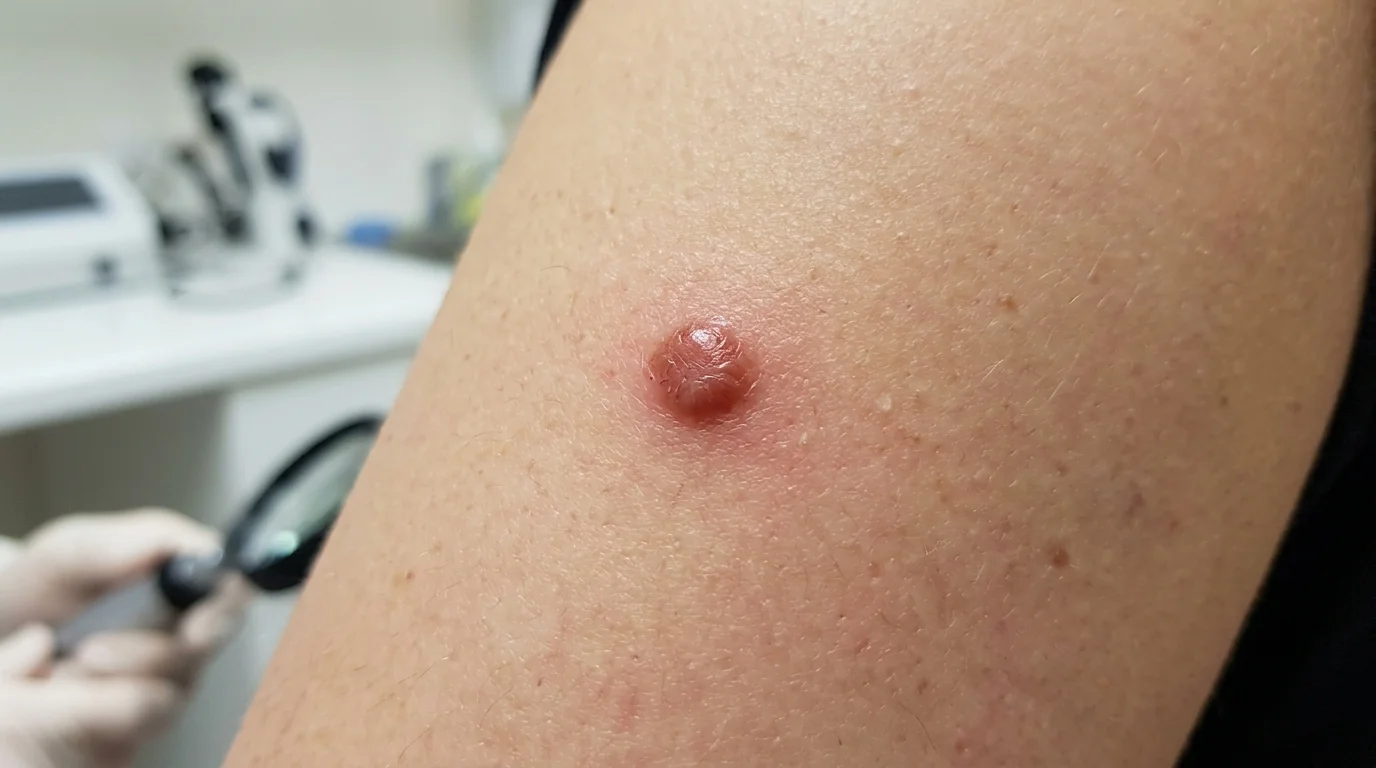
Sometimes, a skin growth can initially be mistaken for an ordinary spot or pimple. However, appearance alone cannot reliably determine what a lump is.
A persistent bump, especially one that continues changing or growing, should not automatically be assumed to be a pimple.
Example Sentences
- “The doctor examined the lump to determine what it was.”
- “The growth needed further evaluation.”
- “Not every lump is a tumor, and not every tumor is cancerous.”
Tumor or Pimple: Key Differences
When considering tumor or pimple, several general clues can help explain why the two are different.
- A pimple is usually associated with acne and a blocked or inflamed hair follicle.
- A tumor is an abnormal growth of cells.
- Pimples commonly develop relatively quickly.
- Some tumors can develop or enlarge gradually.
- Pimples often improve as inflammation settles.
- A persistent or enlarging lump may require medical assessment.
- Pimples commonly occur in acne-prone areas.
- Tumors can develop in many different tissues.
- A tumor can be benign or malignant.
- A pimple is not a tumor.
- Appearance alone cannot reliably diagnose a tumor.
Tumor or Pimple Comparison Table
| Feature | Pimple | Tumor |
|---|---|---|
| Basic meaning | Inflamed or clogged hair follicle/acne lesion | Abnormal growth or mass of cells |
| Common cause | Clogged pores, oil, inflammation | Abnormal cell growth |
| Cancerous? | No | Sometimes, depending on type |
| Typical location | Acne-prone skin | Can occur in many tissues |
| Appearance | Often red, white, or inflamed | Highly variable |
| Tenderness | Can be tender | May or may not be painful |
| Changes over time | Often settles | May remain or grow |
| Diagnosis | Often recognizable clinically | May require medical examination/testing |
| Treatment | Depends on acne type | Depends on tumor type and location |
Real-Life Conversation Examples
Dialogue 1: A Small Red Spot
Person 1: “I found a red bump on my face. Is it a tumor or pimple?”
Person 2: “It could be a pimple, but you can’t reliably identify every skin lump just by looking at it.”
🎯 Lesson: A new bump shouldn’t automatically be labeled as either a pimple or tumor without appropriate evaluation.
Dialogue 2: A Persistent Lump
Person 1: “This lump hasn’t gone away.”
Person 2: “If it’s persistent or changing, it’s worth asking a healthcare professional about it.”
🎯 Lesson: A lump that doesn’t resolve deserves attention rather than repeated guessing.
Dialogue 3: Painful Bump
Person 1: “It’s sore when I touch it.”
Person 2: “Pain can occur with pimples, but pain alone doesn’t identify what a lump is.”
🎯 Lesson: One symptom usually isn’t enough to determine the cause.
Dialogue 4: Worry About Cancer
Person 1: “Does tumor automatically mean cancer?”
Person 2: “No. Tumors can be benign or malignant.”
🎯 Lesson: The word tumor does not automatically mean cancer.
When to Consider Tumor or Pimple
If you’re wondering about tumor or pimple, don’t focus on one visual feature alone.
A Typical Pimple
A bump is more consistent with an ordinary acne lesion when it appears in an acne-prone area and behaves like other pimples you’ve experienced.
It may:
- Become red
- Feel tender
- Develop a whitehead
- Change over several days
- Gradually improve
However, these observations aren’t a substitute for professional diagnosis.
A Persistent or Unusual Lump
Consider getting medical advice if a bump:
- Continues to grow
- Persists without improving
- Changes noticeably
- Bleeds without an obvious reason
- Becomes increasingly unusual in appearance
- Keeps returning in the same location
- Causes significant concern
These signs do not automatically mean cancer. They simply mean that a healthcare professional may need to examine the area.
Can You Tell a Tumor From a Pimple by Touch?
Not reliably.
People sometimes try to determine the answer to tumor or pimple by deciding whether a bump feels hard, soft, painful, or movable. While these characteristics can provide useful information to a clinician, they are not enough for someone to make a reliable diagnosis at home.
Different skin conditions and benign growths can feel different from one another, and some concerning conditions may not have obvious symptoms.
If you’re worried about a lump, the safest approach is to have it assessed rather than repeatedly pressing or squeezing it.
What About a Pimple That Doesn’t Go Away?
Not every persistent skin bump is a tumor.
Other possibilities can include:
- Cysts
- Ingrown hairs
- Other types of acne
- Benign skin growths
- Inflammation
- Infections
- Other skin conditions
This is why the question “tumor or pimple” cannot always be answered from a photograph or description alone.
If a bump remains for an unusual amount of time, keeps changing, or concerns you, a doctor or dermatologist can help determine what it is.
When Should You See a Doctor?
You should consider speaking with a healthcare professional if you have a lump or skin growth that is persistent, growing, changing, bleeding, or otherwise unusual.
You should also seek medical attention if the area is associated with significant pain, swelling, drainage, fever, or other symptoms suggesting infection.
A healthcare professional may examine the area and, if necessary, recommend additional testing.
Remember that getting a lump checked doesn’t mean something serious has been found. Many lumps and skin growths are harmless.
Why You Shouldn’t Squeeze an Unknown Bump
If you aren’t sure whether something is a pimple, avoid repeatedly squeezing, picking, or puncturing it.
Squeezing a normal pimple can increase irritation and may contribute to scarring or infection. If the bump is something else, attempting to manipulate it can also irritate the area.
When you’re uncertain about a persistent bump, professional evaluation is a better approach than trying to remove it yourself.
Tumor or Pimple: Common Misunderstandings
“Every hard bump is a tumor.”
False. Many harmless conditions can cause firm or hard bumps.
“Every tumor is cancer.”
False. Tumors can be benign or malignant.
“A painful bump must be a pimple.”
False. Pain can occur with many different skin conditions.
“A pimple that lasts longer must be cancer.”
False. Persistent bumps can have many causes, and only an appropriate medical assessment can determine the cause.
“You can always tell by looking.”
False. Some skin conditions look similar, especially in their early stages.
Fun Facts and Medical History
1. Acne Is Extremely Common
Acne is one of the most common skin conditions, particularly during adolescence. It can range from a few occasional pimples to more extensive acne.
2. Tumors Can Be Benign
The term tumor describes an abnormal mass or growth, not necessarily cancer. A benign tumor can remain localized and may not pose the same risks as a malignant tumor.