
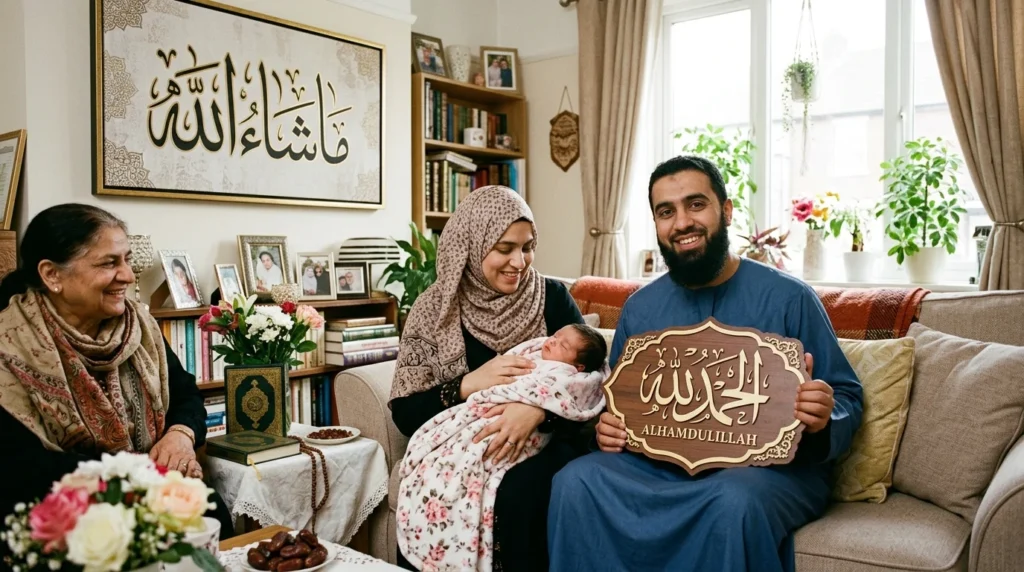
What Is “Mashallah”?
Mashallah is commonly written in English as Masha Allah, Mā shā’ Allāh, or Mashallah. The Arabic phrase is مَا شَاءَ ٱللَّٰهُ, commonly understood as meaning “what Allah has willed” or “what Allah has willed to happen.”
People commonly say Mashallah when admiring something good, beautiful, impressive, or blessed. It can express appreciation while recognizing that the blessing exists by Allah’s will.
When Is Mashallah Used?
You may hear Mashallah when someone:
- Sees a beautiful baby
- Compliments someone’s achievement
- Notices a beautiful home
- Hears good news about someone’s success
- Praises a person’s accomplishment
- Appreciates something beautiful or impressive
For example:
“Your daughter did very well in her exams, Mashallah.”
The expression recognizes the achievement while acknowledging Allah’s will.
Example Sentences
- Mashallah, your garden looks beautiful.
- Your son has learned so much, Mashallah.
- Mashallah, what a wonderful achievement.
- The new house looks beautiful, Mashallah.
A Short History and Usage Note
The phrase comes from Arabic and is widely used by Muslims around the world. Its exact pronunciation and transliteration can vary because Arabic sounds do not always have a single standardized spelling in English.
You may therefore see Mashallah, Masha Allah, and Masha’Allah written in different places.
What Is “Alhamdulillah”?
Alhamdulillah is commonly transliterated from the Arabic ٱلْحَمْدُ لِلَّٰهِ and means “praise be to Allah” or “all praise is due to Allah.”
Unlike Mashallah, which is commonly used when admiring or acknowledging something, Alhamdulillah is primarily an expression of praise and gratitude to Allah.
When Is Alhamdulillah Used?
People commonly say Alhamdulillah when:
- Expressing gratitude for a blessing
- Responding to “How are you?”
- Saying that something went well
- Thanking Allah after receiving good news
- Acknowledging blessings
- Expressing gratitude during both easy and difficult circumstances
For example:
“How are you?”
“Alhamdulillah, I’m doing well.”
Here, the speaker is expressing gratitude to Allah.
Example Sentences
- Alhamdulillah, I finished my work.
- Alhamdulillah, everything went well.
- “How are you?” — “Alhamdulillah, I’m fine.”
- Alhamdulillah for this opportunity.
Regional Usage
Alhamdulillah is used by Muslims across many different countries and cultures. You can hear it in Arabic-speaking countries as well as South Asia, Southeast Asia, Africa, Europe, and other parts of the world.
Because it has become part of everyday Muslim speech, its usage can vary slightly depending on culture and context.
Mashallah or Alhamdulillah: Key Differences
The easiest way to understand Mashallah or Alhamdulillah is to remember their main functions.
- Mashallah is commonly used when admiring or acknowledging a blessing or positive quality.
- Alhamdulillah is commonly used when expressing praise and gratitude to Allah.
- Mashallah focuses more on recognizing something as being by Allah’s will.
- Alhamdulillah focuses more directly on praising and thanking Allah.
- Both expressions can be used when discussing something positive.
- Both phrases are widely used by Muslims around the world.
- Neither expression is limited to one specific language or region.
- Their English spellings can vary because they are transliterations of Arabic.
Mashallah vs Alhamdulillah Comparison Table
| Feature | Mashallah | Alhamdulillah |
|---|---|---|
| Arabic | مَا شَاءَ ٱللَّٰهُ | ٱلْحَمْدُ لِلَّٰهِ |
| Common meaning | What Allah has willed | Praise be to Allah |
| Main purpose | Admiration and acknowledgment | Praise and gratitude |
| Common situation | Seeing something good or impressive | Expressing thanks or reporting how things are |
| Example | “Mashallah, beautiful house.” | “Alhamdulillah, we arrived safely.” |
| Focus | Allah’s will | Praise of Allah |
| Common in everyday speech | Yes | Yes |
| English spellings | Mashallah, Masha Allah, Masha’Allah | Alhamdulillah, Al-Hamdulillah |
Real-Life Conversation Examples
Dialogue 1: Admiring an Achievement
Person 1: “My brother won first place in the competition.”
Person 2: “Mashallah! That’s wonderful.”
🎯 Lesson: Mashallah can be used when admiring someone’s achievement.
Dialogue 2: Expressing Gratitude
Person 1: “How did your exam go?”
Person 2: “Alhamdulillah, it went well.”
🎯 Lesson: Alhamdulillah expresses gratitude for something that happened.
Dialogue 3: Admiring Something Beautiful
Person 1: “Look at their new house!”
Person 2: “Mashallah, it’s beautiful.”
🎯 Lesson: Use Mashallah naturally when admiring something good or beautiful.
Dialogue 4: Responding to “How Are You?”
Person 1: “How are you today?”
Person 2: “Alhamdulillah, I’m doing well.”
🎯 Lesson: Alhamdulillah is commonly used to express gratitude when talking about one’s condition.
Dialogue 5: Combining Both Expressions
Person 1: “Your daughter has done amazingly well in school.”
Person 2: “Mashallah. Alhamdulillah, we’re very grateful.”
🎯 Lesson: The two expressions can appear together because they perform different functions.
When to Use Mashallah or Alhamdulillah
A simple rule can make the distinction much easier.
Use Mashallah When You Admire Something
If you’re looking at something impressive and want to acknowledge it positively, Mashallah is often appropriate.
Think:
“That’s wonderful/beautiful/impressive, by Allah’s will.”
Examples:
- “Mashallah, your artwork is beautiful.”
- “Mashallah, you’ve worked hard.”
- “Mashallah, what a beautiful family.”
Use Alhamdulillah When You Express Gratitude
If you’re thanking or praising Allah for something, Alhamdulillah is usually the better expression.
Think:
“Praise and thanks belong to Allah.”
Examples:
- “Alhamdulillah, I completed my project.”
- “Alhamdulillah, everything worked out.”
- “Alhamdulillah, I’m feeling better.”
A Simple Memory Trick
Remember:
Mashallah = admiration
Alhamdulillah = gratitude
This isn’t a complete explanation of every possible religious context, but it is a useful everyday distinction for English speakers learning how these expressions are commonly used.
Can You Say Mashallah and Alhamdulillah Together?
Yes, both expressions can appear in the same conversation or sentence when their meanings fit the context.
For example:
“Mashallah, you achieved your goal. Alhamdulillah.”
The first expression can acknowledge and admire the achievement, while the second expresses gratitude to Allah.
They aren’t competing expressions. They communicate different ideas and can complement each other.
Is Mashallah Only Used for Beautiful Things?
No. Although Mashallah is frequently heard when someone admires beauty, it is not restricted to physical appearance.
It can also be used for:
- Academic achievements
- Professional accomplishments
- Personal progress
- Talents
- Family blessings
- Good news
- Positive qualities
For example:
“Mashallah, you have learned the language very quickly.”
The phrase can acknowledge something positive without being limited to appearance.
Is Alhamdulillah Only Used When Something Good Happens?
Not necessarily.
Alhamdulillah is fundamentally an expression of praise and gratitude to Allah. Muslims may use it in many circumstances, including ordinary daily situations.
For example, someone might say:
“Alhamdulillah” when asked how they are doing.
It can also be used when acknowledging blessings or expressing gratitude more generally.
The expression therefore has a broader role than simply saying that something went well.
Spelling and Pronunciation Differences
English transliterations can make these expressions look different from one source to another.
For Mashallah, you may see:
- Mashallah
- Masha Allah
- Masha’Allah
- Mā shā’ Allāh
For Alhamdulillah, you may see:
- Alhamdulillah
- Al-Hamdulillah
- Al hamdulillah
- Al-ḥamdu lillāh
These variations generally reflect different approaches to representing Arabic sounds using English letters.
If you’re writing for a general English-speaking audience, Mashallah and Alhamdulillah are among the most recognizable spellings.
US vs UK English Notes
Unlike words such as color/colour or favorite/favourite, Mashallah and Alhamdulillah don’t have standard American and British spelling versions.
The main variation comes from Arabic transliteration, not from US versus UK English rules.
That means an American Muslim and a British Muslim may use different spellings online while referring to the same Arabic expression.
For SEO content, consistency is usually more useful than trying to treat one transliteration as an American spelling and another as a British spelling.
Fun Facts and History
1. Both Expressions Come From Arabic
Mashallah and Alhamdulillah are Arabic expressions that have become widely recognized among Muslims across different languages and cultures.
2. Transliteration Creates Multiple Spellings
Arabic uses a different writing system from English. When Arabic expressions are written using English letters, there can be several reasonable transliteration styles.
That’s why you’ll find Mashallah and Masha Allah, as well as Alhamdulillah and Al-Hamdulillah, across websites and social media.