

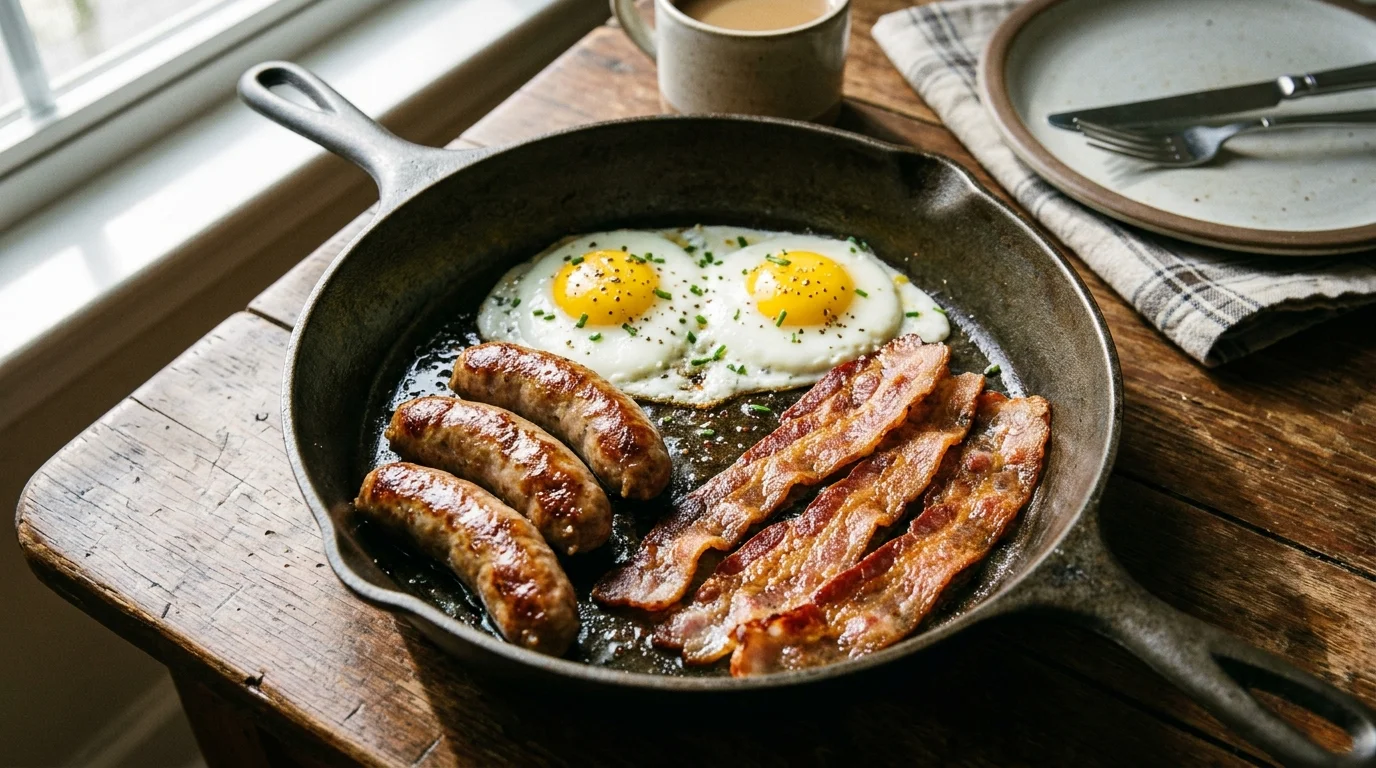
What Is “Sausage”?
Sausage is a broad food category made from ground, minced, or finely chopped meat mixed with seasonings and other ingredients. The mixture may be stuffed into a casing, shaped into patties, or formed into other shapes.
Pork is a traditional sausage ingredient, but sausages can also be made from beef, chicken, turkey, lamb, or other meats. Some modern varieties are plant-based.
Meaning and Usage
The word sausage generally refers to the finished food rather than one specific cut of meat.
Common examples include:
- Breakfast sausage
- Italian sausage
- Bratwurst
- Chorizo
- Chicken sausage
- Turkey sausage
- Vegetarian or plant-based sausage
For example:
“I had sausage and eggs for breakfast.”
“Let’s add sausage to the pizza.”
“She bought some chicken sausage for dinner.”
Because sausage is a broad category, the exact ingredients and preparation method depend on the variety.
Grammar Rules
Sausage can be used as a countable or uncountable noun depending on context.
For example:
“I bought three sausages.”
Here, the word refers to individual pieces.
You can also say:
“We had sausage for breakfast.”
Here, it refers to the food generally.
The plural form is usually sausages when referring to individual items.
A Short History of Sausage
Sausage-making is an ancient food-preservation tradition. Different cultures developed their own versions using available meats, spices, herbs, and preservation techniques.
The basic idea was practical: grinding or chopping meat allowed cooks to use various parts of an animal while seasoning and preserving the mixture.
Today, sausage has become a global food category with thousands of regional variations.
What Is “Bacon”?
Bacon is traditionally made from cured pork, usually from specific cuts of the animal. It is commonly sliced into strips and then cooked by frying, baking, grilling, or another method.
Bacon is known for its salty, savory flavor and crisp texture when cooked.
Meaning and Usage
When people say bacon without further explanation, they commonly mean cured pork bacon.
Examples include:
“I had bacon with my eggs.”
“Can you add bacon to the sandwich?”
“The bacon is getting crispy.”
Unlike sausage, bacon is generally associated with a cured cut of meat, rather than ground meat formed into a sausage.
Grammar Rules
Bacon is usually treated as an uncountable noun when referring to the food generally.
For example:
“I bought some bacon.”
You can also refer to individual pieces or slices:
“Three slices of bacon.”
The word bacons is generally not used when talking about individual pieces of the food.
History and Usage
Bacon has a long history of curing pork as a method of preservation. Different cultures developed different forms of cured pork, and the term can refer to different cuts and preparation styles depending on the region.
Today, bacon is strongly associated with breakfast in many English-speaking countries, although it is also widely used as an ingredient in other dishes.
Key Differences Between Sausage and Bacon
The main difference between sausage or bacon is how the meat is prepared.
- Sausage is generally made from ground or minced meat.
- Bacon is traditionally made from cured cuts of pork.
- Sausage can come in links, patties, rolls, or other forms.
- Bacon is commonly sold as slices or strips.
- Sausage usually contains seasonings mixed throughout the meat.
- Bacon gets much of its characteristic flavor from curing and, in many varieties, smoking.
- Sausage has many different varieties across cultures.
- Bacon also varies by region, cut, curing method, and style.
Sausage or Bacon Comparison Table
| Feature | Sausage | Bacon |
|---|---|---|
| Basic definition | Ground/minced meat mixed with seasonings | Traditionally cured pork |
| Typical form | Links, patties, rolls | Slices or strips |
| Meat preparation | Ground or chopped | Usually a whole cut |
| Seasoning | Often mixed into the meat | Primarily from curing and sometimes smoking |
| Common texture | Juicy, firm, or crumbly depending on type | Tender to crisp depending on cooking |
| Common breakfast use | Yes | Yes |
| Varieties | Extremely diverse | Many regional varieties |
| Can be made from poultry? | Yes | Some bacon-style products can use poultry |
| Plant-based versions | Common | Available as bacon-style alternatives |
| Main distinction | Ground/minced and seasoned | Cured cut of meat |
The easiest way to remember the difference is:
Sausage is usually ground and seasoned. Bacon is traditionally cured and sliced.
Real-Life Conversation Examples
Dialogue 1: Breakfast
Mia: Do you want sausage or bacon with your eggs?
Noah: Bacon, please. I like it crispy.
Mia: Good choice. I’ll make some bacon.
🎯 Lesson: Both are common breakfast foods, but they are different types of meat products.
Dialogue 2: Pizza
Alex: Should we add sausage or bacon to the pizza?
Sam: Sausage. I want something more substantial.
Alex: Sounds good.
🎯 Lesson: Sausage and bacon can both be toppings, but their texture and flavor are different.
Dialogue 3: Understanding the Difference
Nora: Aren’t sausage and bacon basically the same thing?
Ella: Not really. Sausage is usually made from ground meat, while bacon is traditionally a cured cut of pork.
Nora: That makes sense.
🎯 Lesson: The preparation and form of the meat are key differences.
Dialogue 4: At the Grocery Store
Ben: Where should I look for the sausage?
Clerk: It’s in the refrigerated meat section. The bacon is on the same aisle.
Ben: Thanks!
🎯 Lesson: Stores often place sausage and bacon near each other because both are commonly sold as breakfast meats.
When to Use Sausage vs Bacon
The choice depends on what you want from the meal.
Choose Sausage When You Want:
- A seasoned meat mixture
- Links or patties
- A wide range of flavors
- A filling breakfast option
- A pizza or pasta ingredient
- Crumbled meat for recipes
Sausage is particularly versatile because different varieties can taste dramatically different.
For example, a mild breakfast sausage and a spicy chorizo-style sausage can provide completely different flavors.
Choose Bacon When You Want:
- Thin, savory strips
- A smoky or salty flavor
- A crisp topping
- A breakfast side
- A sandwich ingredient
- A garnish for salads or baked dishes
Bacon is often chosen when a dish needs a strong savory flavor and crisp texture.
Memory Trick
Think:
Sausage = seasoned mixture
Bacon = cured slices
That simple distinction will help you remember the difference between sausage or bacon.
Are Sausage and Bacon the Same Type of Food?
Not exactly.
Both can be categorized as processed meat products when they are made from animal meat and subjected to processes such as curing, grinding, seasoning, or smoking. However, their production methods are different.
Sausage generally involves grinding or mincing meat, adding seasonings and other ingredients, and then forming the mixture.
Bacon traditionally involves curing a cut of pork and often smoking it before it is sliced and cooked.
So while both may appear on the same breakfast plate, they are made differently.
Sausage or Bacon: Which Has More Varieties?
Both have enormous variety.
Sausage Varieties
Sausage can vary according to:
- Meat
- Seasonings
- Grinding texture
- Curing
- Smoking
- Cooking method
- Regional traditions
- Casing type
Examples include breakfast sausage, bratwurst, chorizo, Italian sausage, and many others.
Bacon Varieties
Bacon can vary according to:
- Cut of meat
- Curing method
- Smoking
- Thickness
- Region
- Cooking style
In different countries, the word bacon can refer to somewhat different cuts and styles.
US vs UK English Notes
The basic words sausage and bacon are used in both American and British English.
However, the specific types people picture can differ.
In the United States, “bacon” commonly brings to mind thin strips of cured pork belly. In the United Kingdom, back bacon is particularly common and comes from a different cut, often including loin as well as belly.
Sausage varieties also differ significantly between countries.
Therefore, when discussing sausage or bacon, the general categories remain the same, but the exact product can vary by region.
Common Mistakes to Avoid
Mistake 1: Calling Bacon a Sausage
Bacon is not a sausage simply because both are breakfast meats.
Sausage is generally made from ground or minced meat, while bacon is traditionally a cured cut.
Mistake 2: Assuming All Sausage Is Pork
Pork is common, but sausage can also be made from beef, chicken, turkey, lamb, or plant-based ingredients.
Mistake 3: Assuming All Bacon Looks the Same
Bacon styles vary by country and cut. Thin American-style bacon and British back bacon, for example, are noticeably different products.
Mistake 4: Thinking Sausage Has One Flavor
Sausage is a huge category. Different herbs, spices, meats, and production methods can create very different flavors.
Fun Facts and History
1. Sausage Has Ancient Roots
Sausage-making developed as a practical way to use and preserve meat. Ancient societies created their own forms of seasoned meat mixtures, leading to the enormous variety of sausages we have today.
2. Bacon Has a Long Curing Tradition
Before modern refrigeration, curing meat with salt was an important preservation method. Bacon developed from this broader tradition of preserving pork.
Over time, smoking, seasoning, and regional techniques created the many bacon styles known today.