

What Is an “OR Gate”?
An OR gate is a basic digital logic gate. It performs the logical OR operation on one or more binary inputs.
The fundamental rule is simple:
The output is 1 if at least one input is 1.
The output is 0 only when all inputs are 0.
OR gate truth table
For a two-input OR gate:
| Input A | Input B | Output |
|---|---|---|
| 0 | 0 | 0 |
| 0 | 1 | 1 |
| 1 | 0 | 1 |
| 1 | 1 | 1 |
The logical expression is:
Y = A + B
Here, the plus sign represents the logical OR operation, not ordinary arithmetic addition.
Example of an OR gate
Imagine a warning system with two switches.
- Switch A detects one condition.
- Switch B detects another condition.
- The alarm should activate if either condition occurs.
An OR gate can perform this function.
If either input becomes 1, the output becomes 1.
OR gate applications
OR gates are commonly used in:
- Digital control systems
- Alarm circuits
- Decision-making circuits
- Computer processors
- Communication systems
- Control logic
- Combinational logic circuits
Short history of the OR gate
The logical OR operation comes from Boolean algebra, developed by George Boole in the 19th century. As digital electronics developed, Boolean logic became fundamental to designing electronic computing systems.
OR gates can now be implemented using several semiconductor technologies, including CMOS.
What Is “CMOS”?
CMOS stands for Complementary Metal-Oxide-Semiconductor.
Unlike an OR gate, CMOS is not a particular logical operation. It is a technology used to construct electronic circuits.
CMOS uses complementary types of MOSFETs, commonly called:
- PMOS transistors
- NMOS transistors
These transistors are arranged so that digital circuits can perform logical operations efficiently.
How CMOS works
A CMOS logic circuit uses complementary transistor networks.
One network generally helps pull the output toward the positive supply voltage, while another helps pull it toward ground.
This arrangement contributes to CMOS’s well-known low static power consumption.
CMOS applications
CMOS technology is widely used in:
- Microprocessors
- Memory chips
- Digital logic
- Microcontrollers
- Sensors
- Integrated circuits
- Consumer electronics
Modern digital electronics rely heavily on CMOS technology.
CMOS is not a logic function
This distinction is important.
You can have:
- CMOS AND gates
- CMOS OR gates
- CMOS NAND gates
- CMOS NOR gates
- CMOS XOR gates
- CMOS inverters
Therefore, CMOS describes the implementation technology, while an OR gate describes the logical function.
OR Gate or CMOS: Key Differences
The most important difference between OR gate and CMOS is that they belong to different categories.
- An OR gate is a logical function.
- CMOS is a semiconductor circuit technology.
- An OR gate defines what the output should be.
- CMOS describes one way that electronic hardware can implement that function.
- An OR gate can be implemented using CMOS.
- CMOS can implement many other logic functions besides OR.
- OR gates are described using Boolean logic and truth tables.
- CMOS circuits are described using transistors and semiconductor structures.
Comparison Table
| Feature | OR Gate | CMOS |
|---|---|---|
| What is it? | Logic gate/function | Semiconductor technology |
| Main purpose | Performs logical OR | Builds electronic circuits |
| Output behavior | 1 when at least one input is 1 | Depends on the circuit being implemented |
| Uses transistors? | At the hardware level, yes | Specifically based on MOS transistor technology |
| Boolean logic | Directly represents OR | Used to implement Boolean functions |
| Truth table | Yes | Depends on the CMOS circuit |
| Can implement other logic? | It is specifically OR | Yes, many logic functions |
| Common use | Digital decision logic | Integrated digital electronics |
| Full name | OR logic gate | Complementary Metal-Oxide-Semiconductor |
| Category | Digital logic | Circuit technology |
Real-Life Conversation Examples
Dialogue 1: Basic Definition
Student: Is CMOS another name for an OR gate?
Teacher: No. An OR gate is a logic function, while CMOS is a technology used to build circuits.
🎯 Lesson: OR gate = logic function; CMOS = implementation technology.
Dialogue 2: CMOS OR Gate
Student: Can an OR gate be made using CMOS?
Teacher: Yes. CMOS technology can be used to implement an OR logic function.
🎯 Lesson: CMOS can be used to build an OR gate.
Dialogue 3: Other CMOS Gates
Student: Does CMOS only make OR gates?
Teacher: No. CMOS can implement many types of digital logic, including NAND, NOR, AND, XOR, and NOT functions.
🎯 Lesson: CMOS is broader than a single logic gate.
Dialogue 4: Truth Tables
Student: Does CMOS have an OR truth table?
Teacher: CMOS itself doesn’t define an OR truth table. The truth table depends on the logic function implemented by the CMOS circuit.
🎯 Lesson: An OR gate has an OR truth table; CMOS describes how circuits can be constructed.
When to Use OR Gate or CMOS
The correct term depends on what you are describing.
Use “OR gate” when discussing logic
Use OR gate when you are talking about:
- Boolean logic
- Truth tables
- Digital logic diagrams
- Binary inputs and outputs
- Logical conditions
- Circuit functions
For example:
The OR gate produces a HIGH output when at least one input is HIGH.
Use “CMOS” when discussing circuit technology
Use CMOS when you are talking about:
- MOSFET-based circuit design
- Integrated circuits
- Semiconductor technology
- Low-power digital electronics
- CMOS logic families
- Chip design
For example:
The circuit uses CMOS technology to implement its digital logic.
Use “CMOS OR gate” when you mean both
If you are specifically discussing an OR gate built using CMOS technology, the most precise phrase is:
CMOS OR gate
This combines the function with the implementation technology.
How a CMOS Circuit Can Implement an OR Function
A CMOS OR function can be constructed using CMOS transistor networks.
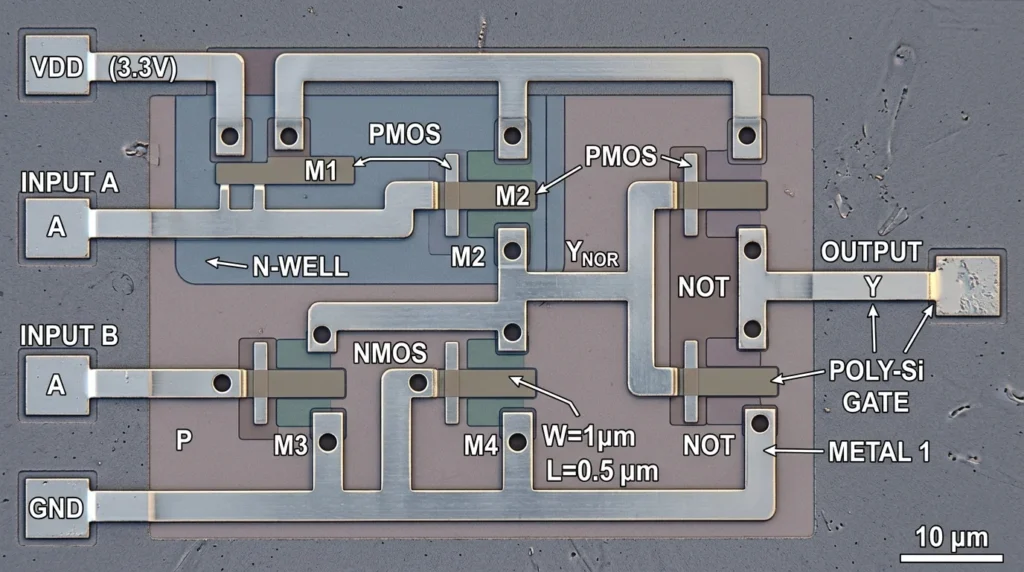
In practical digital design, an OR function is commonly implemented using a combination of CMOS structures. For example, a CMOS NOR gate can be followed by a CMOS inverter to produce an OR function.
Conceptually:
A OR B = NOT(NOR(A, B))
This is based on Boolean logic.
The important point is that the OR operation is the desired logic function, while CMOS provides the transistor-level technology used to implement it.
CMOS vs OR Gate in Digital Electronics
When studying electronics, it helps to think of the two terms as answers to different questions.
Question: “What should the circuit do?”
Answer:
OR gate
The OR function determines the relationship between inputs and output.
Question: “How can we build the circuit?”
One possible answer:
CMOS
CMOS provides a transistor-based technology for implementing the desired logic.
This distinction makes terms such as CMOS OR gate, CMOS NAND gate, and CMOS inverter much easier to understand.
Easy Memory Trick
Remember this simple formula:
OR = WHAT the circuit does
CMOS = HOW the circuit can be built
For example:
CMOS OR gate
means an OR logic function implemented using CMOS technology.
This is one of the easiest ways to remember the relationship between the two terms.
Common Mistakes to Avoid
Mistake 1: Saying CMOS and OR gate are synonyms
They are not.
CMOS describes a semiconductor technology, while an OR gate describes a logical operation.
Mistake 2: Assuming CMOS only means digital logic gates
CMOS technology is widely used for digital logic, but the term covers a broader semiconductor technology.
Mistake 3: Assuming every OR gate is CMOS
OR gates can be implemented using different technologies. CMOS is one important implementation technology.
Mistake 4: Confusing OR with NOR
An OR gate produces 1 when at least one input is 1.
A NOR gate is the inverted form of OR.
For two inputs:
OR: Y = A + B
NOR: Y = NOT(A + B)
That small distinction is important in digital circuit design.
Fun Facts About OR Gates and CMOS
1. CMOS is known for low static power consumption
One major advantage of CMOS digital circuits is their very low static power consumption under ideal steady-state conditions, although real circuits still consume power during switching and due to leakage.
2. CMOS is used in modern processors
CMOS technology has become fundamental to modern integrated circuits, including many processors, memory devices, and other digital chips.
Quick Answer: OR Gate or CMOS?
If you are describing a logical operation, use OR gate.
If you are describing a semiconductor technology, use CMOS.
If you are describing an OR function specifically implemented using CMOS, use:
CMOS OR gate
The easiest rule is:
OR gate = logic function
CMOS = circuit technology