
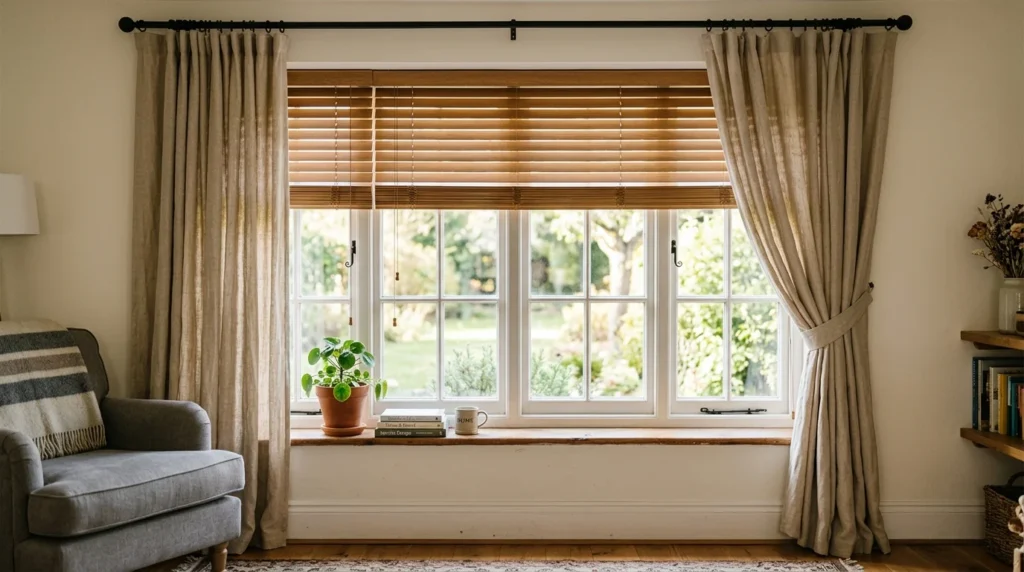
Choosing between shades or curtains can be confusing because both are used to cover windows, control light, and improve privacy. However, they are not the same type of window treatment. Shades are generally made from fabric or another continuous material that rolls, folds, or raises as one piece. Curtains are usually fabric panels that hang from a rod or track and can be opened by moving them to the side.
Although they look/sound similar, they serve completely different purposes.
Understanding shades or curtains can help you make a better choice for bedrooms, living rooms, offices, kitchens, and other spaces. In this guide, we will explain their meanings, differences, advantages, practical uses, examples, and regional terminology so you can confidently decide which option works best for your needs.
What Are “Shades”?
Shades are window coverings made from a continuous piece of material. They are usually attached to the top of a window and can be raised, lowered, rolled, folded, or adjusted to control light and privacy.
Unlike curtains, which normally consist of hanging fabric panels, shades stay close to the window.
Common types of shades
There are several types of window shades, including:
- Roller shades
- Roman shades
- Cellular shades
- Woven shades
- Solar shades
- Pleated shades
- Blackout shades
Each type works somewhat differently.
For example, roller shades roll around a tube when raised, while Roman shades fold into sections as they are lifted.
Examples of “shades”
- We installed shades in the bedroom for better light control.
- These shades block much of the sunlight during the afternoon.
- The office windows have simple roller shades.
- She chose woven shades to create a natural look.
What do shades do?
Depending on their material and design, shades can help:
- Reduce sunlight
- Improve privacy
- Reduce glare
- Control indoor brightness
- Add insulation
- Create a clean, streamlined appearance
Some shades are specifically designed to block outside light, while others allow filtered light to enter.
Short history of shades
Window shades have existed in various forms for centuries, although modern roller and fabric shade systems developed alongside improvements in textiles, manufacturing, and window hardware.
Today, shades are widely used in homes, offices, hotels, and commercial buildings.
What Are “Curtains”?
Curtains are pieces or panels of fabric that hang vertically around a window. They are usually attached to a curtain rod, track, or pole.
Curtains can be opened and closed by pulling the fabric across the window.
They are available in countless colors, patterns, fabrics, lengths, and styles.
Common types of curtains
Popular curtain styles include:
- Blackout curtains
- Sheer curtains
- Thermal curtains
- Lined curtains
- Eyelet curtains
- Pleated curtains
- Panel curtains
- Decorative curtains
Some curtains are mainly decorative, while others are designed to provide privacy, insulation, or strong light blocking.
Examples of “curtains”
- We bought new curtains for the living room.
- The curtains block the morning sunlight.
- She opened the curtains to let in more natural light.
- These long curtains make the room feel more comfortable.
What do curtains do?
Curtains can help with:
- Privacy
- Light control
- Decoration
- Insulation
- Reducing drafts
- Improving the overall appearance of a room
Because curtains are available in many fabrics, they are often chosen as much for their appearance as for their practical function.
Short history of curtains
Curtains have been used for centuries as decorative and practical coverings. Early versions were often made from heavy textiles and could help divide spaces, provide privacy, or reduce drafts.
Modern curtains are available in lightweight, decorative, insulating, and specialized fabrics.
Shades or Curtains: Key Differences
The biggest difference between shades or curtains is how they are constructed and operated.
- Shades are usually one continuous covering attached close to the window.
- Curtains are usually fabric panels hanging from a rod or track.
- Shades generally move up and down.
- Curtains generally move side to side.
- Shades provide a streamlined appearance.
- Curtains can create a softer, more decorative appearance.
- Both can provide privacy and light control.
- Some rooms benefit from using both together.
Comparison Table
| Feature | Shades | Curtains |
|---|---|---|
| Basic design | Continuous window covering | Hanging fabric panels |
| Typical movement | Up and down | Side to side |
| Position | Close to the window | Hang away from the window |
| Materials | Fabric, woven material, synthetic materials, etc. | Primarily fabric |
| Privacy | Excellent depending on style | Excellent depending on fabric |
| Light control | Excellent | Excellent |
| Decoration | Clean and streamlined | Wide range of decorative styles |
| Space required | Usually less | Usually more |
| Insulation | Depends on design | Can be excellent with lined or thermal fabrics |
| Maintenance | Depends on material | Often removable for cleaning |
| Common installation | Window frame or above window | Rod, pole, or track |
| Can be used together? | Yes | Yes |
Real-Life Conversation Examples
Dialogue 1: Choosing for a Bedroom
Mia: Should we buy shades or curtains for the bedroom?
Noah: If you want a simple look and adjustable light control, shades could work well.
Mia: What if we want a softer decorative style?
Noah: Then curtains might be a better choice.
🎯 Lesson: Shades offer a streamlined appearance, while curtains provide more fabric-based decoration.
Dialogue 2: Controlling Sunlight
Sam: The afternoon sun is too bright.
Alex: You could install shades to control how much light comes through.
Sam: Would curtains work too?
Alex: Yes, especially blackout or lined curtains.
🎯 Lesson: Both shades and curtains can control sunlight, depending on their material and design.
Dialogue 3: Decorating a Living Room
Emma: The windows look a little plain.
Lily: Try adding curtains.
Emma: Would shades help?
Lily: They could, but curtains may add more softness and visual detail.
🎯 Lesson: Curtains often provide more obvious decorative impact.
Dialogue 4: Small Room
Tom: This room is pretty small. I don’t want anything bulky around the windows.
Sarah: Shades might be a good option because they stay close to the window.
🎯 Lesson: Shades can be useful when you prefer a compact window treatment.
When to Use Shades or Curtains
There is no single correct choice for every room. The best option depends on your priorities.
Choose shades when you want a streamlined look
Shades are a strong choice if you prefer a clean appearance without large amounts of fabric around the window.
They can work especially well in:
- Modern bedrooms
- Offices
- Kitchens
- Minimalist interiors
- Small rooms
Example
We chose simple roller shades for the home office.
Choose curtains when decoration is important
Curtains are a good option when you want to add color, texture, patterns, or softness to a room.
They can work especially well in:
- Living rooms
- Bedrooms
- Dining rooms
- Traditional interiors
- Decorative spaces
Example
We selected long curtains to complement the living room furniture.
Choose both for flexibility
You do not always have to choose one.
Using shades and curtains together can provide layered window coverage. For example, shades can provide adjustable privacy and light control, while curtains add decoration and additional coverage.
Shades vs Curtains for Privacy
Both shades and curtains can provide privacy, but the result depends on the specific product.
A blackout shade can provide significant privacy and light control. Similarly, heavy or lined curtains can block views through a window.
Sheer curtains, on the other hand, may allow considerable light through and may not provide complete privacy at night.
If privacy is your main concern, check the product’s opacity and coverage rather than choosing based solely on whether it is a shade or curtain.
Shades vs Curtains for Light Control
Light control depends heavily on material and construction.
Blackout shades can block most incoming light when properly fitted.
Blackout curtains can also significantly reduce incoming light, especially when they overlap the window effectively.
For flexible control, some homeowners combine a shade with curtains.
The important point is that the specific product matters more than the category alone.
Easy Memory Trick
Here’s a simple way to remember shades or curtains:
Shades = go up and down
Think:
Shade → window covering that rises or lowers.
Curtains = move side to side
Think:
Curtain → fabric panels that open and close across the window.
This isn’t true for every specialized design, but it is a useful general rule for everyday window terminology.
Common Mistakes to Avoid
Mistake 1: Using the words as exact synonyms
Although both are window coverings, shades and curtains are not identical.
A shade is generally a continuous covering, while curtains are typically hanging fabric panels.
Mistake 2: Assuming all shades block all light
Not every shade is a blackout shade. Some are specifically designed to filter or soften sunlight.
Mistake 3: Assuming every curtain provides complete privacy
Sheer curtains may allow people outside to see through them under certain lighting conditions.
Always consider the fabric and opacity.
Mistake 4: Confusing blinds with shades
Blinds usually contain slats or vanes that can be tilted or raised.
Shades generally use a continuous material.
For example:
- Roller shade = continuous material
- Venetian blind = horizontal slats
- Curtains = hanging fabric panels
These distinctions can be useful when shopping or describing a window treatment.
US vs UK English: Shades or Curtains
The terminology can vary somewhat by region.
In American English, shade commonly refers to a window covering made from continuous material, such as a roller shade or Roman shade.
In British English, the term blind is often used for products that Americans may call shades.
For example, an American might say:
We installed roller shades.
A British speaker might commonly say:
We installed roller blinds.
However, curtains is a familiar term in both American and British English.
This regional difference is important if you are writing product descriptions or SEO content for an international audience.
Fun Facts About Shades and Curtains
1. Curtains can serve more than one purpose
Curtains are not only decorative. Heavy or lined curtains can also help reduce light, improve privacy, and provide some insulation.
2. Shades can be highly customizable
Modern shades are available in many materials, colors, patterns, and operating systems. Some can be manually adjusted, while others may use motorized controls.
Quick Answer: Shades or Curtains?
Choose shades when you want:
- A streamlined appearance
- A window covering that stays close to the glass
- Up-and-down operation
- Flexible light control
- A compact solution
Choose curtains when you want:
- Fabric panels
- More decorative options
- Side-to-side opening
- Softness and texture
- Additional visual impact
You can also use both if you want layered light control, privacy, and decoration.
Conclusion
The difference between shades or curtains comes down mainly to their construction, movement, and appearance. Shades are generally continuous window coverings that sit close to the window and move up or down. Curtains are usually fabric panels that hang from a rod or track and move from side to side.
Both can provide privacy, light control, and style, so the best choice depends on your room and personal needs. If you want a streamlined look, shades may be ideal. If you want softness and decorative impact, curtains may be the better option. For maximum flexibility, consider using both.