
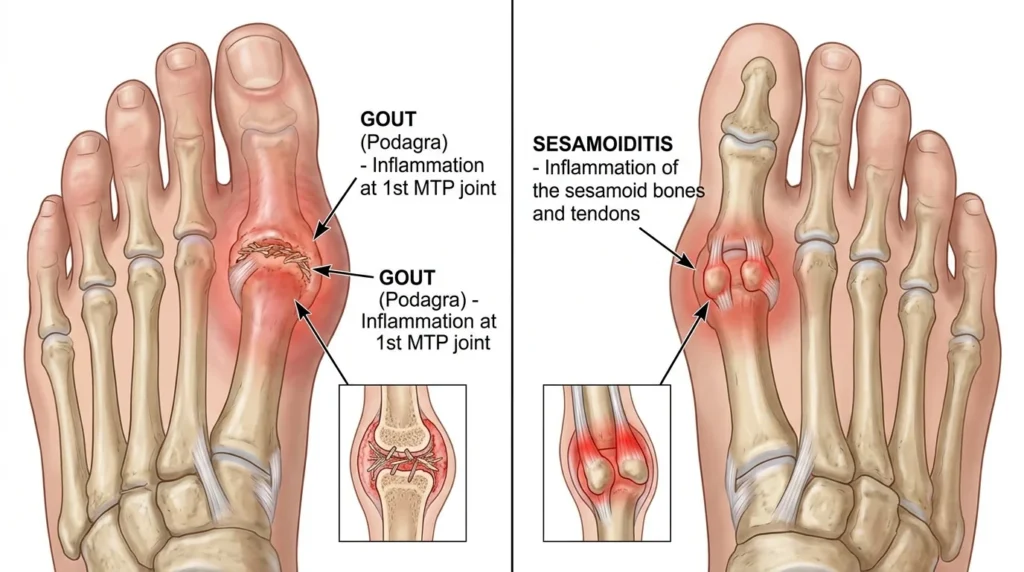
Pain around the big toe can have several causes, and gout or sesamoiditis is a comparison that can be confusing because both conditions may cause pain in the front of the foot. However, they are not the same condition. Gout is a form of inflammatory arthritis caused by urate crystals building up in a joint, while sesamoiditis is inflammation and irritation involving the small sesamoid bones and nearby tendons beneath the big toe joint.
Although they look/sound similar, they serve completely different purposes. More accurately, they can produce similar symptoms but have different underlying causes.
Understanding gout or sesamoiditis can help explain why pain beneath or around the big toe may need a proper medical evaluation rather than a guess based on symptoms alone. This guide compares their causes, symptoms, diagnosis, and general treatment approaches.
What Is “Gout”?
Gout is a form of inflammatory arthritis that can cause sudden, intense pain in a joint. It most commonly affects the joint at the base of the big toe, although it can affect other joints as well.
Gout develops when urate crystals accumulate in a joint. These crystals can trigger a strong inflammatory response, leading to pain, swelling, warmth, and redness.
Common Symptoms of Gout
A gout attack often begins suddenly and can be particularly intense. Common symptoms include:
- Severe joint pain
- Swelling
- Warmth
- Redness or discoloration
- Tenderness
- Difficulty moving the affected joint
The big toe is especially commonly affected. Mayo Clinic notes that gout symptoms can develop suddenly, often at night, with pain frequently reaching its worst during the first several hours.
What Causes Gout?
Gout is associated with elevated levels of uric acid, which can lead to urate crystal formation in joints. The body produces uric acid when it breaks down substances called purines, and the kidneys normally remove much of it through urine.
Several factors can contribute to higher uric acid levels, including genetics, certain medical conditions, some medications, and dietary factors.
Example Sentences
- “The doctor suspected gout because of the sudden pain and swelling in the big toe.”
- “Gout commonly affects the joint at the base of the big toe.”
- “The patient was evaluated for gout after developing sudden joint pain.”
What Is “Sesamoiditis”?
Sesamoiditis is inflammation and irritation involving the sesamoid bones and the tendons surrounding them. The sesamoids are two small bones located beneath the big toe joint in the ball of the foot.
These small bones help absorb pressure and provide leverage when the foot moves. Repetitive stress can irritate the bones and surrounding tissues.
Common Symptoms of Sesamoiditis
Symptoms can include:
- Pain beneath the big toe
- Pain in the ball of the foot
- Tenderness over the sesamoid area
- Swelling
- Difficulty putting weight on the front of the foot
- Pain when moving or bending the big toe
Unlike a typical sudden gout attack, sesamoiditis often develops gradually, particularly when repetitive activity places repeated stress on the area.
What Causes Sesamoiditis?
Repetitive pressure and stress are common causes. Activities that repeatedly place weight on the ball of the foot can increase the risk.
Examples include:
- Running
- Dancing
- Certain sports
- Repetitive jumping
- Wearing high heels
- Activities that place substantial pressure beneath the big toe
Cleveland Clinic also notes that injuries and certain other foot conditions can contribute to sesamoid inflammation.
Example Sentences
- “The runner developed sesamoiditis after repeatedly putting stress on the ball of the foot.”
- “Sesamoiditis caused tenderness beneath the big toe.”
- “The doctor examined the sesamoid area for signs of inflammation.”
Gout or Sesamoiditis: Key Differences
The most important difference between gout or sesamoiditis is their underlying cause.
- Gout involves urate crystals and inflammation within a joint.
- Sesamoiditis involves inflammation and irritation around the small sesamoid bones beneath the big toe.
- Gout often develops suddenly.
- Sesamoiditis commonly develops gradually through repetitive stress.
- Gout commonly produces a hot, swollen, very tender joint.
- Sesamoiditis typically causes localized pain beneath the big toe and in the ball of the foot.
- Gout can affect multiple joints.
- Sesamoiditis specifically involves the sesamoid region of the forefoot.
- The two conditions can sometimes be difficult to distinguish based on symptoms alone.
Comparison Table
| Feature | Gout | Sesamoiditis |
|---|---|---|
| Condition type | Inflammatory arthritis | Inflammation/overuse condition |
| Main cause | Urate crystals in a joint | Repetitive stress or irritation |
| Common location | Joint at base of big toe | Beneath big toe joint |
| Onset | Often sudden | Often gradual |
| Pain | Often intense and sudden | Often activity-related |
| Swelling | Common | Can occur |
| Warmth/redness | Common during attacks | May occur locally |
| Activity connection | Not usually the main cause | Often important |
| Diagnosis | Clinical assessment plus testing when needed | Physical exam and sometimes imaging |
| Treatment | Depends on gout and attack status | Usually reducing stress and treating inflammation |
Real-Life Conversation Examples
Dialogue 1: Sudden Big-Toe Pain
Alex: “My big toe suddenly became extremely painful and swollen.”
Doctor: “Gout is one possibility, but we need to evaluate the joint to determine the cause.”
🎯 Lesson: Sudden, intense pain and swelling can occur with gout, but diagnosis requires proper evaluation.
Dialogue 2: Pain After Running
Sam: “The area beneath my big toe hurts whenever I run.”
Trainer: “Repeated pressure can contribute to sesamoiditis, so you should have it assessed.”
🎯 Lesson: Activity-related pain beneath the big toe can occur with sesamoiditis.
Dialogue 3: Similar Location
Patient: “Both gout and sesamoiditis can hurt around the big toe. How can I tell?”
Clinician: “The location, timing, examination, and sometimes tests help distinguish them.”
🎯 Lesson: Similar symptoms do not necessarily mean the same diagnosis.
Dialogue 4: Checking the Cause
Patient: “Can I diagnose it from the pain alone?”
Clinician: “It’s better not to. Several foot and joint problems can cause similar symptoms.”
🎯 Lesson: Pain location alone isn’t enough to reliably distinguish the conditions.
When to Consider Gout vs Sesamoiditis
There are some general clues, but they should not be used as a substitute for medical diagnosis.
Gout May Be More Likely When:
The symptoms involve:
- Sudden onset
- Severe joint pain
- Significant swelling
- A hot or inflamed joint
- Redness or discoloration
- Previous episodes of similar joint inflammation
Gout most commonly affects the joint at the base of the big toe.
Sesamoiditis May Be More Likely When:
Symptoms involve:
- Gradual development
- Pain directly beneath the big toe
- Pain in the ball of the foot
- Tenderness over the sesamoid bones
- Symptoms that become worse with activities that load the forefoot
- Difficulty putting pressure on the front of the foot
These are characteristic patterns associated with sesamoiditis, but other injuries can cause similar symptoms.
How Is Gout Diagnosed?
A healthcare professional may consider your symptoms, medical history, and physical examination.
Testing may include:
- Blood testing for uric acid
- Examination of joint fluid
- X-rays
- Ultrasound
- Dual-energy CT in selected situations
A key point is that a high blood uric acid level alone does not prove that someone has gout. Similarly, uric acid can sometimes be normal during a gout attack.
When necessary, examining joint fluid for urate crystals can help establish the diagnosis.
How Is Sesamoiditis Diagnosed?
A healthcare professional usually examines the foot and checks for localized tenderness, inflammation, and pain with movement of the big toe.
Depending on the situation, imaging may be used to look for fractures or other problems. Possible tests include:
- X-rays
- Bone scans
- CT scans
- MRI
This is important because pain in the sesamoid area can sometimes come from a sesamoid fracture or another foot injury, rather than simple inflammation.
Treatment Differences
Treatment depends on the diagnosis, severity, and individual circumstances.
Gout Treatment
Treatment for gout may involve medications designed to reduce inflammation and pain during an attack. Longer-term treatment may also be used for people who need to lower uric acid and reduce the risk of future attacks.
A healthcare professional determines which treatment is appropriate based on the person’s symptoms and medical history.
Sesamoiditis Treatment
Treatment generally focuses on reducing stress on the affected area and allowing irritated tissues to recover.
A healthcare professional may recommend approaches such as:
- Rest from aggravating activities
- Appropriate footwear
- Ice and elevation
- Temporary support or taping
- Orthotic devices
- Physical therapy
- Other treatment for persistent symptoms
Cleveland Clinic notes that severe or persistent cases may require additional medical treatment.
Can Gout Cause Sesamoiditis?
Interestingly, there can be a connection.
Cleveland Clinic lists gout as one of the conditions that can contribute to sesamoiditis-like inflammation.
This illustrates why simply choosing between “gout” and “sesamoiditis” based on location can be misleading. A healthcare professional may need to determine whether the pain is coming from a joint, the sesamoid structures, an injury, or another condition.
Common Mistakes to Avoid
Mistake 1: Assuming Every Big-Toe Problem Is Gout
The big toe is a common location for gout, but other conditions can cause pain there.
Mistake 2: Assuming Activity-Related Pain Is Always Sesamoiditis
Running or other activities can cause several types of foot injuries. Persistent pain should be assessed rather than self-diagnosed.
Mistake 3: Using a Uric Acid Test Alone
A uric acid blood test can provide useful information, but it doesn’t by itself confirm or rule out gout.
Mistake 4: Ignoring Persistent Pain
Ongoing foot pain can have multiple causes, including fractures and other joint or soft-tissue problems. Proper assessment can help identify the actual cause.
Fun Facts and History
1. The Sesamoid Bones Are Tiny but Important
The foot has two small sesamoid bones beneath the big toe joint. They are embedded within tendons and help with movement and weight-bearing.
2. Gout Has a Strong Connection With the Big Toe
Although gout can affect many joints, the joint at the base of the big toe is its most common location.
When Should You See a Doctor?
Sudden, intense joint pain—especially if the joint is hot, swollen, and inflamed—should be medically evaluated. Mayo Clinic specifically advises seeking medical care for sudden severe joint pain and prompt attention if fever occurs with a hot, inflamed joint, because infection can sometimes produce similar symptoms.
For suspected sesamoiditis, persistent pain, difficulty bearing weight, or pain after an injury also deserves professional evaluation.
Gout or Sesamoiditis: Quick Answer
The easiest way to remember the difference is:
Gout = urate-crystal inflammation in a joint.
Sesamoiditis = inflammation and irritation around the sesamoid bones beneath the big toe.
Gout often starts suddenly and can cause severe swelling, warmth, redness, and tenderness. Sesamoiditis commonly develops from repetitive stress and causes localized pain beneath the big toe, particularly when putting pressure on the front of the foot.
Because the symptoms can overlap with other foot conditions, a healthcare professional should make the diagnosis.
Conclusion
When comparing gout or sesamoiditis, the key difference is the source of the inflammation. Gout is an inflammatory arthritis associated with urate crystals in a joint, while sesamoiditis involves irritation and inflammation around the small sesamoid bones and nearby tendons beneath the big toe. Gout often appears suddenly with intense joint pain and swelling, whereas sesamoiditis commonly develops gradually after repeated stress on the forefoot.
Because several conditions can cause similar symptoms, don’t rely on symptoms alone for a diagnosis. If big-toe or foot pain is severe, persistent, or accompanied by significant swelling, warmth, or fever, seek medical evaluation.