
What Is “Wagyu”?
Wagyu literally means “Japanese cow” or “Japanese cattle.” The term comes from Japanese: wa means Japanese, while gyu means cattle.
In food discussions, Wagyu generally refers to beef from recognized Japanese cattle breeds and their breeding lines. The four Japanese breeds traditionally recognized as Wagyu are:
- Japanese Black
- Japanese Brown
- Japanese Shorthorn
- Japanese Polled
Japanese Black is particularly well known for producing highly marbled beef.
What Makes Wagyu Special?
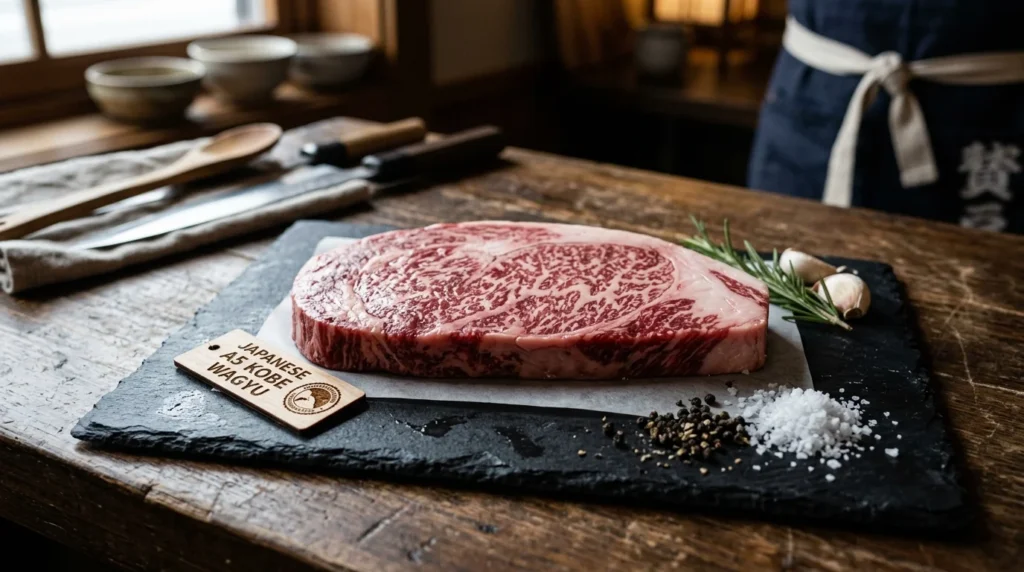
Wagyu is famous for its intramuscular fat, commonly called marbling. Instead of having all the fat concentrated around the outside of a cut, Wagyu can have fine streaks of fat distributed throughout the muscle.
This marbling can contribute to:
- Rich flavor
- A soft, tender texture
- A distinctive mouthfeel
- High levels of perceived richness
However, not every piece of beef labeled “Wagyu” is identical. The country of origin, breed, genetics, feeding practices, grading system, and production standards can all affect the final product.
Japanese Wagyu vs Wagyu From Other Countries
The word Wagyu is also used outside Japan. Countries such as the United States and Australia produce cattle with Wagyu genetics.
That means a product can legitimately be described as Wagyu without being Japanese Wagyu.
This distinction is important when comparing Kobe or Wagyu because genuine Kobe beef comes from a very specific Japanese production system.
Example Sentences
- “Japanese Wagyu is known for its exceptional marbling.”
- “The restaurant offers Australian Wagyu.”
- “Not every Wagyu steak is Kobe beef.”
- “Wagyu can refer to beef produced from Japanese cattle genetics.”
What Is “Kobe”?
Kobe beef is a specific type of Japanese beef associated with Hyogo Prefecture and the city of Kobe.
It comes from cattle belonging to the Tajima strain of Japanese Black cattle and must meet specific standards to qualify as genuine Kobe beef.
This is the crucial point:
Kobe beef is Wagyu, but not all Wagyu is Kobe beef.
Think of it as a category-and-subcategory relationship.
Wagyu → Japanese Wagyu → Japanese Black → Tajima cattle → qualifying Kobe beef
Not every animal in those broader categories qualifies for the Kobe designation.
Why Is Kobe Beef So Special?
Genuine Kobe beef has to meet strict requirements involving factors such as:
- Breed and lineage
- Origin
- Production area
- Carcass standards
- Meat quality
- Yield
- Marbling and other grading criteria
These requirements protect the reputation and identity of authentic Kobe beef.
Example Sentences
- “The restaurant advertises certified Kobe beef.”
- “Kobe beef comes from Hyogo Prefecture.”
- “Kobe is a specific type of Japanese Wagyu.”
- “Not every Japanese Wagyu steak qualifies as Kobe beef.”
Kobe or Wagyu: Key Differences
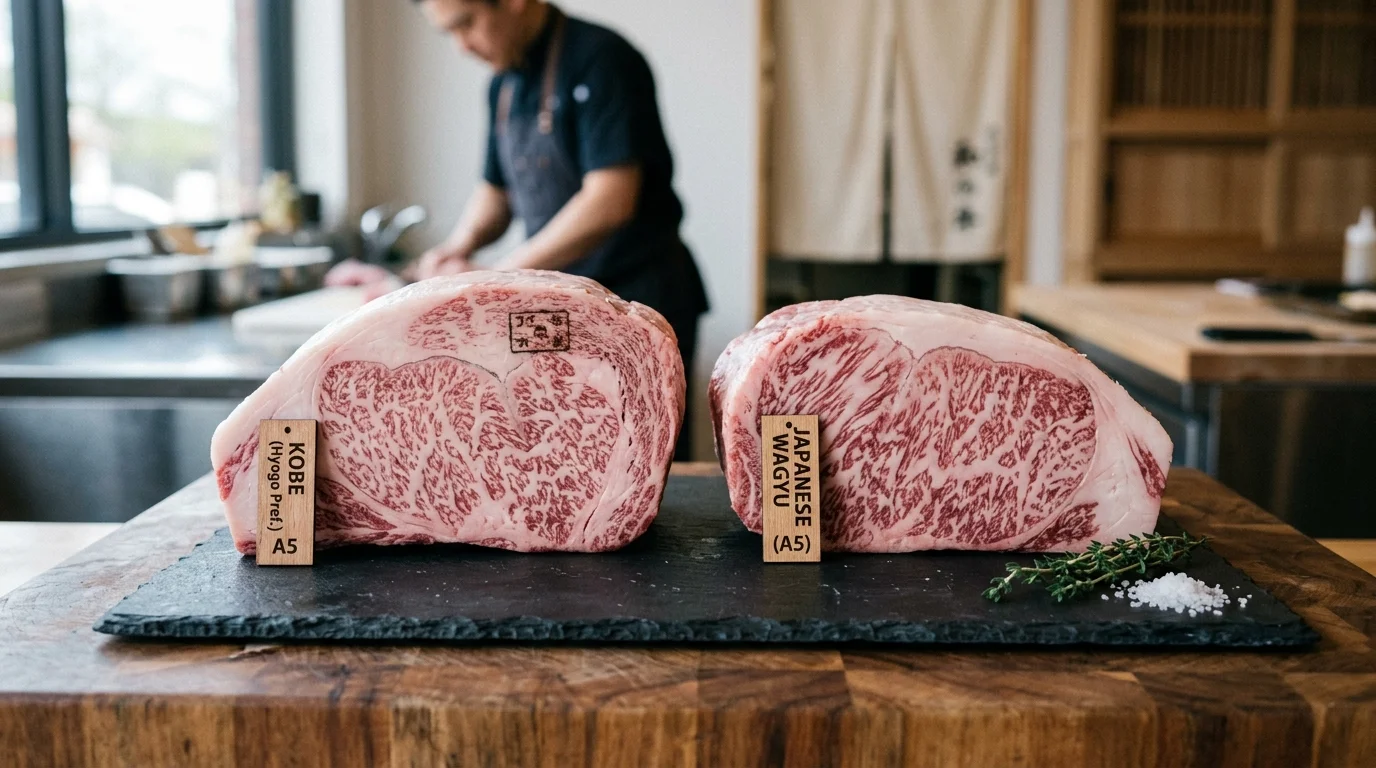
The biggest difference between Kobe or Wagyu is specificity.
- Wagyu is a broad category associated with Japanese cattle and their beef.
- Kobe is a specific regional and certified type of Wagyu beef.
- Kobe beef comes from qualifying Tajima cattle.
- Genuine Kobe beef must meet strict standards.
- Wagyu can be produced in Japan or, depending on the product, in other countries using Wagyu genetics.
- Japanese Wagyu is not automatically Kobe beef.
- Kobe beef is therefore a much narrower category.
Comparison Table
| Feature | Wagyu | Kobe |
|---|---|---|
| Meaning | Japanese cattle / beef from Wagyu cattle | Specific certified beef from Hyogo |
| Category | Broad | Specific |
| Origin | Japan or other countries for Wagyu-derived products | Hyogo Prefecture, Japan |
| Breed connection | Four recognized Japanese Wagyu breeds | Tajima strain of Japanese Black |
| Marbling | Often highly marbled | Characteristically highly marbled |
| Certification | Depends on product and origin | Strict certification requirements |
| Can it be Japanese? | Yes | Yes |
| Is all Wagyu Kobe? | No | — |
| Is Kobe Wagyu? | Yes | Yes |
Real-Life Conversation Examples
Dialogue 1: Ordering at a Restaurant
Customer: “Is this Wagyu steak Kobe?”
Server: “Not necessarily. Kobe is a specific type of Wagyu.”
🎯 Lesson: A Wagyu steak is not automatically Kobe beef.
Dialogue 2: Comparing Menus
Alex: “This menu says Japanese Wagyu, but the other says Kobe.”
Sam: “Kobe is a much more specific designation.”
🎯 Lesson: Kobe identifies a specific certified category within Japanese Wagyu.
Dialogue 3: Buying Beef
Customer: “The package says Wagyu. Does that mean it’s Kobe?”
Butcher: “No. You need to verify the specific origin and certification.”
🎯 Lesson: The word Wagyu alone does not establish that beef is Kobe.
Dialogue 4: Discussing Quality
Mia: “Which is better, Kobe or Wagyu?”
Chef: “That’s not quite an apples-to-apples comparison because Kobe is a specific type of Wagyu.”
🎯 Lesson: Kobe and Wagyu are related categories, not direct equivalents.
When to Use Kobe or Wagyu
Choosing between the terms depends on what you are actually describing.
Use “Wagyu” When:
Use Wagyu when talking generally about beef from Wagyu cattle.
For example:
“This restaurant serves Japanese Wagyu.”
Or:
“Wagyu is famous for its marbling.”
If the beef comes from a country outside Japan, specify the origin when relevant:
“Australian Wagyu”
or
“American Wagyu”
This gives readers a clearer picture of what they are buying or eating.
Use “Kobe” When:
Use Kobe beef only when the product genuinely meets the requirements for the Kobe designation.
For example:
“This restaurant serves certified Kobe beef.”
Avoid using Kobe simply as a synonym for “very high-quality Wagyu.” The term identifies a specific product with specific standards.
Easy Memory Trick
Remember this simple rule:
Wagyu = the big category
Kobe = a specific type within that category
A useful analogy is:
Fruit → Apple
You wouldn’t say every fruit is an apple. In the same way, you shouldn’t say every Wagyu steak is Kobe.
Is Kobe Better Than Wagyu?
This question is slightly misleading because Kobe is Wagyu.
If you’re comparing authentic Kobe beef with another specific Wagyu product, the answer depends on what you value.
Factors can include:
- Marbling
- Flavor
- Texture
- Cut
- Grading
- Origin
- Production methods
- Authenticity
- Price
A high-quality Wagyu steak that isn’t Kobe can still be an exceptional piece of beef.
Likewise, the word “Wagyu” alone doesn’t guarantee that every product will have exactly the same quality.
Japanese Wagyu vs Kobe Beef
This is an especially important distinction.
Japanese Wagyu is a broad category of beef from qualifying Japanese Wagyu cattle.
Kobe beef is a much narrower designation with strict requirements connected to Hyogo Prefecture and Tajima cattle.
Therefore:
All authentic Kobe beef is Japanese Wagyu.
But:
Not all Japanese Wagyu is Kobe beef.
This is one of the easiest ways to understand Kobe or Wagyu.
Why Is Kobe Beef So Expensive?
Authentic Kobe beef can command high prices because production involves specific cattle genetics, geographic requirements, quality standards, certification, and limited supply.
The reputation of Kobe beef also contributes to its premium positioning.
However, high price alone does not prove that a steak is genuine Kobe. Authenticity depends on meeting the relevant requirements and being properly identified and certified.
Common Mistakes to Avoid
Mistake 1: Saying Kobe and Wagyu Are Completely Different
They aren’t. Kobe is a type of Wagyu.
Mistake 2: Calling Every Wagyu Steak Kobe
This is one of the most common mistakes.
Wagyu is a broad category, while Kobe is specific.
Mistake 3: Assuming Japanese Wagyu Automatically Means Kobe
Japanese Wagyu can come from different regions and cattle lines. Kobe is specifically connected to qualifying Tajima cattle from Hyogo.
Mistake 4: Using “Kobe” as a Generic Word for Premium Beef
Kobe is not simply another word for expensive or highly marbled beef.
Mistake 5: Assuming Imported Wagyu Is Kobe
Wagyu cattle and Wagyu genetics are used in several countries. Imported Wagyu is not automatically Kobe beef.
Fun Facts and History
1. Kobe Beef Is Named After Kobe
The name comes from Kobe, the major city in Hyogo Prefecture. The beef’s identity is strongly connected to the wider Hyogo region and its cattle-production system.
2. Marbling Is a Major Feature
One of the characteristics that makes premium Wagyu famous is its high degree of intramuscular fat, creating the distinctive marbled appearance associated with the beef.
How to Tell if Kobe Beef Is Genuine
If you’re paying a premium for something advertised as Kobe beef, don’t rely solely on the word “Kobe” on a menu.
Look for information about:
- Certification
- Origin
- Hyogo Prefecture
- Tajima lineage
- Official identification or documentation
- The restaurant or supplier’s ability to verify authenticity
A reputable seller should be able to explain what makes the product genuine Kobe beef.
Kobe or Wagyu: Quick Answer
Here’s the simplest answer:
Wagyu is the broader category. Kobe is a specific type of Wagyu beef.
So:
Kobe ⊂ Wagyu
That means every authentic Kobe steak is Wagyu, but most Wagyu steaks are not Kobe.
If you see “Wagyu” on a menu, don’t automatically assume you’re getting Kobe. Check the country, region, cattle type, grading, and certification if authenticity matters.