
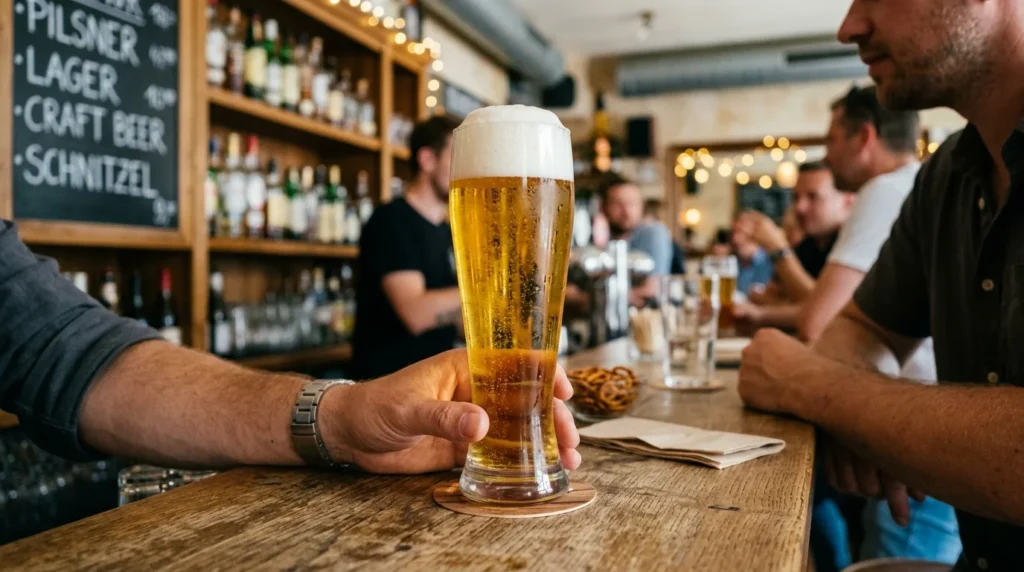
Pilsner and lager are not completely separate categories. A pilsner is actually a type of lager. This is the key point to remember when comparing pilsner or lager.
The word lager describes a broad family of beers made using bottom-fermenting yeast and typically fermented and conditioned at relatively cool temperatures. Pilsner is a specific lager style that originated in the city of Plzeň (Pilsen), in what is now the Czech Republic.
Because pilsners are lagers, every traditional pilsner is a lager, but not every lager is a pilsner.
What Is a Lager?
A lager is a broad category of beer. The term covers many different styles with different colors, flavors, strengths, and bitterness levels.
Lagers are generally known for being:
- Clean-tasting
- Crisp
- Smooth
- Refreshing
- Relatively low in fruity yeast character
However, not all lagers taste the same.
Types of Lager
Examples include:
- Pilsner
- Helles
- Märzen
- Dunkel
- Bock
- Vienna lager
- Schwarzbier
These beers can range from pale and light to dark and malty.
What Does Lager Taste Like?
Because “lager” includes many styles, there isn’t one single lager flavor.
A lager might be:
- Light and crisp
- Malty
- Toasty
- Bitter
- Smooth
- Dark and roasted
The specific style determines the flavor.
What Is a Pilsner?
A pilsner is a pale lager style that originated in Plzeň, Czech Republic, in the 19th century.
Pilsners are typically recognized for their:
- Pale golden appearance
- Crisp character
- Noticeable hop bitterness
- Floral or spicy hop aroma
- Clean finish
- Refreshing character
There are several recognized pilsner traditions, including Czech, German, and other interpretations.
Czech Pilsner
Czech pilsners are often characterized by:
- Pronounced hop bitterness
- Spicy or herbal hop character
- Soft maltiness
- Golden color
- Balanced finish
German Pilsner
German pilsners are often:
- Pale
- Crisp
- Dry
- Hop-forward
- Clean
- Moderately bitter
The exact character varies between breweries and individual beers.
Pilsner or Lager: Key Differences
The easiest way to understand pilsner or lager is to think of the relationship like this:
Lager = category
Pilsner = style within that category
Key Differences
- Lager is a broad beer category.
- Pilsner is a specific lager style.
- Pilsners are usually pale and highly refreshing.
- Lagers can be pale, amber, or dark.
- Pilsners commonly have noticeable hop bitterness.
- Some lagers are much more malt-forward.
- Pilsner originated in Plzeň.
- Lager includes many styles besides pilsner.
Comparison Table
| Feature | Pilsner | Lager |
|---|---|---|
| Category | Specific beer style | Broad beer category |
| Fermentation family | Lager | Lager |
| Typical color | Pale/golden | Pale to dark |
| Hop bitterness | Often noticeable | Varies widely |
| Flavor | Crisp, clean, hop-forward | Varies by style |
| Origin | Plzeň, Czech Republic | Broad European brewing tradition |
| Examples | Czech pilsner, German pilsner | Pilsner, Helles, Märzen, Dunkel, Bock |
| Relationship | A type of lager | Includes pilsner |
Real-Life Conversation Examples
Dialogue 1: Understanding the Category
Emma: “Is pilsner a type of lager?”
Liam: “Yes. Pilsner is one specific style of lager.”
🎯 Lesson: This is the most important distinction.
Dialogue 2: Ordering Beer
Sarah: “I want something pale, crisp, and noticeably hoppy.”
Tom: “A pilsner style may fit that description.”
🎯 Lesson: Pilsners are commonly pale and hop-forward.
Dialogue 3: Talking About Lager
Mike: “I like lager.”
Anna: “Which kind? There are many different lager styles.”
🎯 Lesson: “Lager” alone doesn’t describe one exact flavor profile.
When to Use “Pilsner”
Use pilsner when you’re specifically talking about that particular pale lager style.
For example:
I enjoy the crisp bitterness of a pilsner.
This brewery makes a Czech-style pilsner.
If you know the beer is specifically a pilsner, calling it simply a “lager” is technically broader but less specific.
When to Use “Lager”
Use lager when you’re referring to the broader category or when the exact style isn’t important.
For example:
This brewery produces several types of lager.
I usually prefer lager-style beers.
If someone says they like lager, it doesn’t necessarily mean they prefer pilsner.
Pilsner vs. Other Lagers
Pilsner is only one member of the lager family.
Pilsner vs. Helles
A Helles is generally pale and clean but tends to emphasize malt more than a typical pilsner.
Pilsner vs. Märzen
Märzen is typically more amber-colored and malt-forward.
Pilsner vs. Dunkel
Dunkel is a darker lager with more pronounced malt and roasted characteristics.
Pilsner vs. Bock
Bock is generally a stronger, malt-forward lager style.
This shows why “lager” is too broad to describe one specific taste.
Why Are Pilsners So Popular?
Pilsners became influential because they combined a pale appearance with a clean, refreshing character and distinctive hop bitterness.
The style spread from Central Europe and influenced brewing around the world.
Many modern commercial lagers are inspired by the general characteristics associated with pale lagers, although they may not technically be pilsners.
Common Mistakes
Mistake 1: Thinking Pilsner and Lager Are Completely Separate
They aren’t. Pilsner is a type of lager.
Mistake 2: Assuming Every Lager Is a Pilsner
That’s also incorrect.
Lager is the broader category.
Mistake 3: Assuming All Lagers Taste the Same
Lagers include many different styles.
Mistake 4: Thinking Pilsner Means Any Pale Beer
Not every pale lager is technically a pilsner.
Mistake 5: Ignoring Regional Styles
Czech and German pilsners, for example, can have noticeably different characteristics.
A Simple Memory Trick
Remember:
Lager = family
Pilsner = member of the family
It’s similar to saying:
Fruit → apple
An apple is a fruit, but not every fruit is an apple.
Likewise:
Lager → pilsner
A pilsner is a lager, but not every lager is a pilsner.
Fun Facts or History
Fact 1: Pilsner Comes From a Place Name
The style gets its name from Plzeň, also known historically as Pilsen.
Fact 2: Pilsner Is a Relatively Young Beer Style
The original pilsner style emerged in the 19th century, making it much younger than some traditional beer styles.
Fact 3: Pilsner Influenced Brewing Worldwide
The popularity of pale pilsner-style beer had a major influence on the development of modern pale lagers.
Conclusion
When choosing between pilsner or lager, remember that the two terms aren’t direct opposites. Pilsner is a specific type of lager, while lager is a much broader category containing many different styles.
If you want a pale, crisp beer with noticeable hop character, a pilsner may be the more specific description. If you’re talking about the broader family of cool-fermented beers, lager is the correct general term.
The simplest rule is: